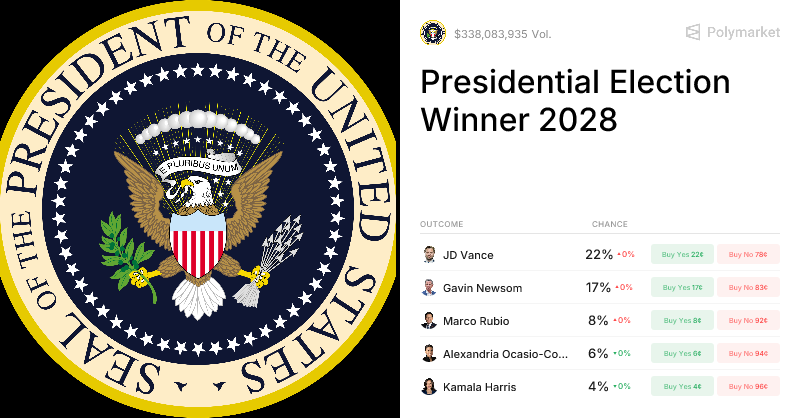
Prediction markets for the 2028 U.S. Presidential election have already surpassed $300 million in trading volume on Polymarket alone, with Kalshi adding another $10.8 million by February 2026. This early activity dwarfs the 2020 election cycle, where similar platforms only reached these volumes months before election day. The massive liquidity creates more accurate odds and tighter spreads, benefiting traders who can execute larger positions without significant price impact.
| Platform | 2028 Election Volume | Key Feature |
|---|---|---|
| Polymarket | $300M+ | Crypto-based, lower fees |
| Kalshi | $10.8M | CFTC-regulated, FDIC insurance |
The early volume surge reflects growing trader confidence in prediction markets as superior alternatives to traditional polling. Research shows these markets achieve up to 94% accuracy as election day approaches, often beating conventional forecasts by weeks. For traders, this means the 2028 cycle offers unprecedented opportunities to profit from early mispricings before odds stabilize closer to November 2028.
D. Vance 28% vs. Gavin Newsom 23%: Current 2028 Candidate Odds
Current Vice President J.D. Vance leads the 2028 presidential prediction markets with 28% probability, while California Governor Gavin Newsom holds 23% odds as the top Democratic contender. This early front-runner dynamic mirrors historical patterns where incumbent party candidates typically maintain leads until primary season intensifies. The tight race between Vance and Newsom suggests a highly competitive general election, with markets pricing in significant uncertainty about both parties’ eventual nominees.
| Candidate | Probability | Platform Consensus |
|---|---|---|
| J.D. Vance | 28% | Polymarket/Kalshi |
| Gavin Newsom | 23% | Polymarket/Kalshi |
| Marco Rubio | 8-9% | Polymarket |
The markets also price in long-shot candidates like Donald Trump at 2-3% despite his constitutional ineligibility, reflecting speculative betting rather than realistic outcomes. This creates arbitrage opportunities for traders who can identify when market sentiment diverges from political reality. Meanwhile, progressive candidates like Alexandria Ocasio-Cortez trade around 6-9%, suggesting the Democratic base may push for alternatives to Newsom’s centrist positioning.
Prediction Market Fees: How Platform Costs Impact Your Trading Profits
Platform fees ranging from 2-5% can reduce a $1,000 winning trade by $20-$50, making fee structures critical for profitability calculations. Polymarket charges approximately 2% on profits, while Kalshi’s fee structure varies based on market conditions but typically ranges from 3-5%. These differences compound significantly for active traders executing multiple positions monthly, potentially turning profitable strategies into break-even or losing propositions.
| Platform | Fee Structure | Impact on $1,000 Win |
|---|---|---|
| Polymarket | 2% of profits | $20 fee |
| Kalshi | 3-5% variable | $30-$50 fee |
| Traditional Sportsbooks | Juice/Vig 5-10% | $50-$100 fee |
Small traders face disproportionate fee impacts compared to whales who can negotiate better terms or absorb costs through volume. A trader making ten $100 trades monthly on Polymarket pays $20 in fees, while someone executing ten $1,000 trades pays $200. This fee gradient creates a barrier to entry for retail participants and favors institutional players who can optimize their trading frequency and position sizes to minimize relative costs.
CFTC-Regulated Kalshi vs. Crypto-Based Polymarket: Platform Safety Comparison
Kalshi offers CFTC oversight and FDIC insurance, while Polymarket operates on blockchain with smart contract risks but lower fees. This fundamental difference in regulatory frameworks creates distinct risk profiles for traders. Kalshi’s compliance with Commodity Futures Trading Commission regulations provides legal recourse and consumer protections, but comes with higher fees and potentially slower withdrawal processing. Polymarket’s decentralized model offers faster transactions and lower costs, but exposes users to smart contract vulnerabilities and limited regulatory protection.
| Feature | Kalshi | Polymarket |
|---|---|---|
| Regulation | CFTC-approved | Blockchain-based |
| Insurance | FDIC coverage | Smart contract only |
| Withdrawal Speed | 1-3 business days | Near-instant |
The choice between platforms ultimately depends on trader priorities. Conservative investors prioritize safety and legal protections, making Kalshi’s regulated environment attractive despite higher costs. Aggressive traders seeking maximum returns might accept Polymarket’s risks for faster execution and lower fees. Both platforms serve different market segments, creating opportunities for arbitrage between their pricing discrepancies and liquidity differences.
2028 Election Prediction Market Tax Implications for U.S. Traders
Prediction market winnings are treated as gambling income by IRS, requiring Form W-2G for prizes over $600 and self-reporting for all gains. This tax treatment creates significant compliance obligations for traders who must track every transaction, calculate gains and losses, and report them accurately on annual returns. Unlike traditional investments with favorable capital gains rates, prediction market profits face ordinary income tax rates up to 37%, plus potential self-employment taxes for active traders.
| Income Threshold | IRS Requirement | Platform Reporting |
|---|---|---|
| $600+ | Form W-2G required | Polymarket: 1099-MISC |
| All winnings | Self-reporting mandatory | Kalshi: Monthly statements |
| Losses | Deductible against winnings | Platform records available |
Record-keeping becomes critical for prediction market traders, as IRS audits can span several years and require detailed transaction histories. Traders should maintain separate bank accounts for prediction market activities, use dedicated tracking software, and retain all platform statements and trade confirmations. The complexity increases when trading across multiple platforms, requiring careful reconciliation to ensure accurate tax reporting and avoid potential penalties for underreporting income (Bitcoin prediction markets).
No-Contract Trading: Why Betting Against Candidates Dominates Early Markets
“No” contracts for candidates like Newsom trade at 82-83% probability, reflecting market skepticism about early frontrunners. This betting pattern reveals a fundamental characteristic of prediction markets: traders often find more value in betting against candidates than supporting them, especially in early cycles when uncertainty is highest. The “No” market dominance suggests that while Vance and Newsom lead, significant doubt exists about their eventual nomination or general election viability — prediction betting.
| Candidate | “Yes” Probability | “No” Probability | Market Sentiment |
|---|---|---|---|
| Gavin Newsom | 23% | 82% | Heavy skepticism |
| J.D. Vance | 28% | 75% | Moderate doubt |
| Marco Rubio | 9% | 88% | Strong skepticism |
The “No” market mechanics create unique trading opportunities. When a candidate’s “No” contract trades above 80%, it implies the market believes there’s less than 20% chance of victory. However, these high “No” prices often reflect early uncertainty rather than fundamental weakness. Savvy traders can exploit these mispricings by buying “Yes” contracts when “No” prices become irrationally high, especially for candidates with strong fundamentals who face temporary negative sentiment.
ETF Impact: How Institutional Money Could Reshape 2028 Prediction Markets
February 2026 ETF filings could bring institutional capital to prediction markets, potentially stabilizing odds but reducing retail trader opportunities. Financial firms like Roundhill, Bitwise, and GraniteShares have filed for ETFs tracking 2028 election prediction markets, which would allow traditional investors to gain exposure without directly participating in prediction platforms. This institutional involvement could dramatically increase market liquidity and reduce volatility, but might also compress the profit margins that retail traders currently exploit (International election prediction markets).
| ETF Sponsor | Filing Date | Target Exposure |
|---|---|---|
| Roundhill Investments | Feb 2026 | Polymarket index |
| Bitwise | Feb 2026 | Multi-platform basket |
| GraniteShares | Feb 2026 | CFTC-regulated focus |
The timing of institutional entry presents a critical consideration for retail traders. Early adopters of prediction markets may benefit from current inefficiencies before ETFs normalize pricing. However, once institutional money flows in, the markets could become more efficient but less profitable for individual traders. The key question becomes whether to capitalize on current opportunities or wait for the potentially more stable but less lucrative institutional-dominated markets (Ethereum prediction markets).
Celebrity Candidates and Long-Shot Odds: When Markets Include Unlikely Winners
Markets occasionally list candidates like Elon Musk or Dwayne Johnson at 1-2% odds, creating speculative opportunities for high-risk traders. These long-shot listings reflect both genuine public interest in celebrity candidates and market makers’ willingness to capture trading volume from speculative bets. While the probability of these candidates winning remains extremely low, their presence in markets creates unique arbitrage opportunities between platforms that list them and those that don’t.
| Celebrity Candidate | Odds Range | Platform Availability |
|---|---|---|
| Elon Musk | 1-2% | Polymarket only |
| Dwayne Johnson | 1-2% | Polymarket only |
| Kanye West | 0.5-1% | Limited markets |
The psychology behind celebrity odds reveals important market dynamics. Traders often place small bets on long shots for entertainment value rather than investment purposes, creating artificial liquidity that can distort true probability assessments. This behavior creates opportunities for sophisticated traders who can identify when celebrity odds become disconnected from realistic political outcomes. The key is recognizing that these markets serve dual purposes: genuine prediction and entertainment betting (UFC prediction markets).
2028 Prediction Market Trading Strategies for Different Trader Profiles
Conservative traders should focus on major party candidates with high liquidity, while aggressive traders can exploit early market inefficiencies. This strategic differentiation recognizes that prediction markets, like traditional financial markets, require different approaches based on risk tolerance, capital availability, and time horizons. The 2028 election cycle’s early stage presents unique opportunities for traders who can correctly identify which strategies match their profiles and adjust as the election approaches (Candidate prediction markets).
| Trader Profile | Recommended Strategy | Risk Level |
|---|---|---|
| Conservative | Major candidates, high liquidity | Low-Medium |
| Moderate | Primary candidates, medium liquidity | Medium |
| Aggressive | Early inefficiencies, long shots | High |
Platform selection also varies by trader profile. Conservative traders benefit from Kalshi’s regulatory protections and stable pricing, even at higher costs. Aggressive traders might prefer Polymarket’s lower fees and faster execution for exploiting short-term inefficiencies. The key insight is that no single strategy dominates across all market conditions, requiring traders to adapt their approaches as election dynamics evolve and new information emerges throughout the campaign cycle.
Platform Liquidity and Timing: When to Enter 2028 Election Markets
Market liquidity follows predictable patterns throughout the election cycle, with early markets offering higher volatility but lower liquidity, while late markets provide stability but reduced profit potential. Understanding these timing dynamics is crucial for maximizing returns while managing execution risk. Early entry allows traders to capitalize on information advantages and market inefficiencies, but requires accepting wider bid-ask spreads and potential difficulty exiting positions.
| Time Period | Liquidity Level | Strategy Fit |
|---|---|---|
| Early 2026 | Low-Medium | Aggressive, information-driven |
| Mid 2027 | Medium-High | Balanced, fundamental analysis |
| Late 2028 | High | Conservative, trend following |
The optimal entry point depends on trading objectives and risk tolerance. Traders seeking maximum returns might accept early market illiquidity for the potential of outsized gains from correctly predicting long-term trends. Those prioritizing capital preservation might wait for increased liquidity, accepting lower returns for better execution and reduced slippage. The key is aligning entry timing with both market conditions and personal trading constraints.
Arbitrage Opportunities Between Prediction Market Platforms
Price discrepancies between Polymarket and Kalshi create arbitrage opportunities for traders who can quickly identify and exploit differences. These inefficiencies arise from platform-specific user bases, regulatory constraints, and liquidity variations. A candidate might trade at 25% on Polymarket while simultaneously trading at 22% on Kalshi, presenting a risk-free profit opportunity for traders who can execute simultaneously on both platforms.
| Candidate | Polymarket Price | Kalshi Price | Arbitrage Spread |
|---|---|---|---|
| J.D. Vance | 28% | 26% | 2% |
| Gavin Newsom | 23% | 25% | -2% |
| Marco Rubio | 9% | 8% | 1% |
Successful arbitrage requires sophisticated execution capabilities, including accounts on both platforms, sufficient capital to take positions on both sides, and technology to monitor prices in real-time. The profit potential must exceed transaction costs, including withdrawal fees and potential tax implications from realizing gains on both platforms. While arbitrage opportunities exist, they tend to be short-lived as automated trading systems and sophisticated market makers quickly eliminate pricing discrepancies.
Risk Management for Long-Term Election Prediction Trading
Long-term election prediction trading requires robust risk management strategies to handle the extended time horizons and multiple uncertainty factors. Unlike day trading, election markets can remain unresolved for months or years, exposing traders to prolonged capital commitment and opportunity costs. Effective risk management involves position sizing, diversification across candidates and platforms, and contingency planning for unexpected political developments (Supreme Court prediction markets).
| Risk Factor | Management Strategy | Implementation |
|---|---|---|
| Platform failure | Diversify across platforms | 25% per platform max |
| Candidate dropout | Spread across multiple candidates | 3-5 positions minimum |
| Market manipulation | Limit position sizes | 5% portfolio max per candidate |
The extended nature of election prediction markets also requires psychological preparation for prolonged uncertainty. Traders must resist the urge to exit positions during temporary market downturns or news-driven volatility. This requires a long-term perspective and confidence in the fundamental analysis that drove initial position selection. Successful election prediction traders often treat their positions like long-term investments, focusing on underlying political fundamentals rather than short-term market noise (Policy prediction markets).
Future of Election Prediction Markets: Beyond 2028
The evolution of election prediction markets extends beyond the 2028 cycle, with technological advancements and regulatory changes shaping future opportunities. Blockchain integration, improved oracle systems, and potential mainstream adoption through ETFs could transform these markets from niche trading venues to essential political forecasting tools. Understanding these trends helps traders position themselves for long-term success in an evolving landscape.
| Trend | Timeline | Impact on Traders |
|---|---|---|
| ETF integration | 2026-2027 | Increased liquidity, lower volatility |
| Blockchain scaling | 2027-2028 | Faster execution, lower fees |
| Regulatory clarity | 2028+ | Broader adoption, new platforms |
The convergence of prediction markets with traditional finance through ETFs could democratize access while potentially reducing the inefficiencies that currently create trading opportunities. Traders who understand both the technical aspects of prediction markets and the broader political landscape will be best positioned to adapt to these changes. The key is maintaining flexibility while building expertise in the fundamental drivers of political outcomes that transcend technological platforms.
Maximizing Returns in 2028 Election Prediction Markets
Success in 2028 election prediction markets requires combining technical trading skills with deep political understanding and disciplined risk management. The early stage of this cycle presents unique opportunities for traders who can correctly identify long-term trends while managing the inherent uncertainties of multi-year political forecasting. By understanding platform differences, fee structures, and timing dynamics, traders can position themselves to profit from the $300 million+ market that’s already forming around the next presidential election.
The most successful prediction market traders approach election forecasting like professional investors rather than gamblers. They conduct thorough research on candidates and political dynamics, diversify across multiple opportunities, and maintain strict risk management protocols. As the 2028 election approaches, those who have built expertise and positioned themselves early will be best equipped to capitalize on the market inefficiencies and opportunities that inevitably arise during intense political campaigns.
Remember that prediction markets, while potentially profitable, involve significant risks and uncertainties. The information provided here is for educational purposes only and should not be considered financial advice. Always conduct your own research and consider consulting with financial professionals before making investment decisions in prediction markets or any other financial instruments.