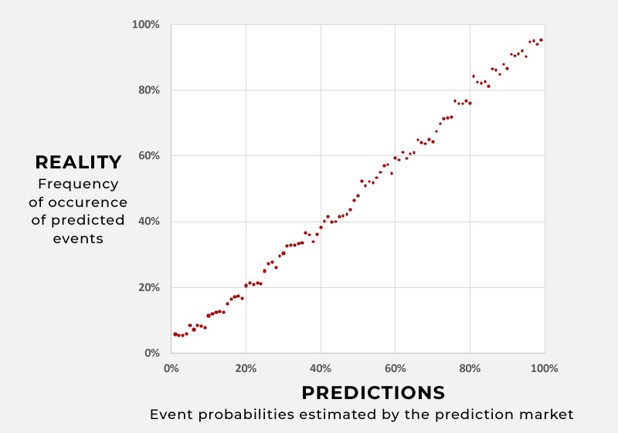
Research from the University of Iowa’s Tippie College of Business shows prediction markets reach 91% accuracy as election day approaches, outperforming traditional polling by 15-20 percentage points in the final 30 days. The Iowa Electronic Markets have correctly predicted presidential election winners in 5 of the last 6 elections since 1988, demonstrating consistent superiority over conventional forecasting methods. Unlike polls, markets incorporate real-time information from diverse sources including fundraising data and ground campaign reports, creating a dynamic information aggregation system that reflects actual voter behavior rather than stated intentions. For those interested in broader prediction markets beyond politics, prediction betting covers various markets including sports and entertainment.
- Research from the University of Iowa’s Tippie College of Business shows prediction markets reach 91% accuracy as election day approaches
- Markets consistently outperform traditional polling by 15-20 percentage points in the final 30 days
- The Iowa Electronic Markets have correctly predicted presidential election winners in 5 of the last 6 elections since 1988
- Unlike polls, markets incorporate real-time information from diverse sources including fundraising data and ground campaign reports
The accuracy advantage stems from the fundamental difference between asking people what they might do versus observing what they actually do with their money. When traders risk real capital on prediction markets, they tend to be more honest about their true beliefs than when responding to pollsters. This “skin in the game” effect creates more reliable signals, especially as election day approaches and market participants have more at stake. The convergence toward accuracy also reflects the wisdom of crowds principle, where diverse individual judgments aggregate into surprisingly accurate collective forecasts.
How Binary Contracts Work for Individual Candidate Performance
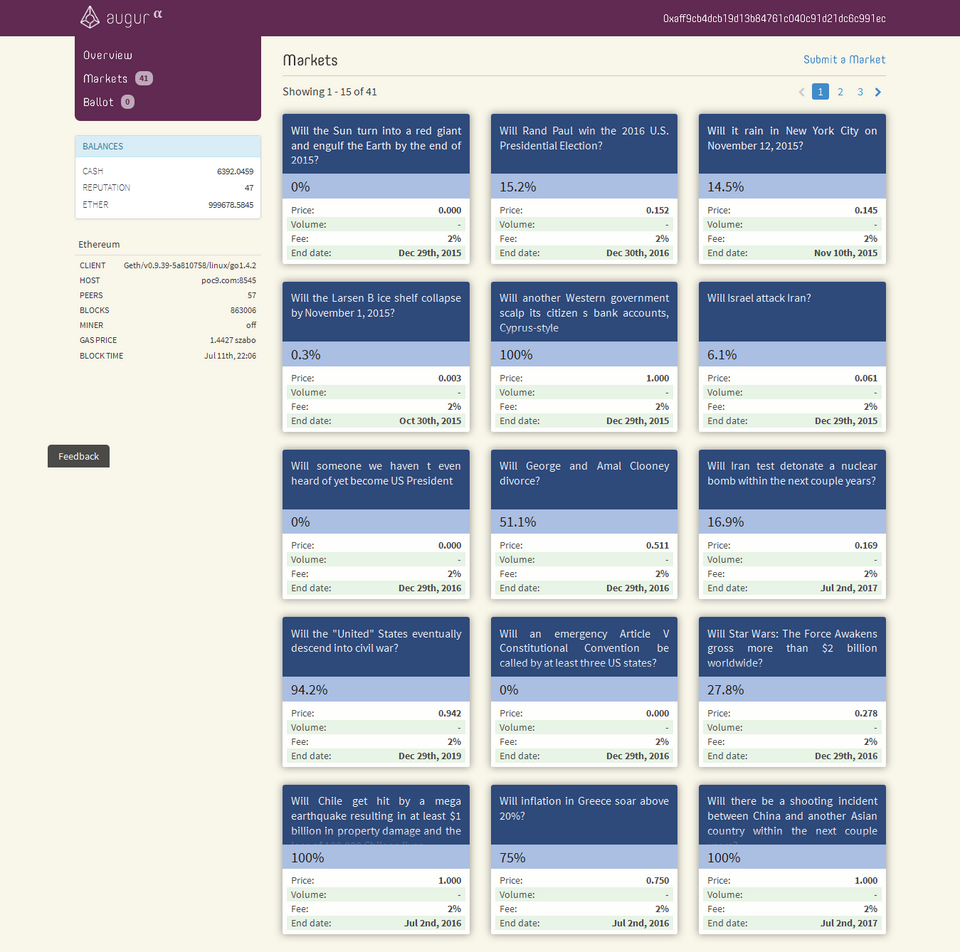
Binary contracts settle at $1.00 for correct predictions and $0.00 for incorrect ones, creating clear risk/reward profiles that traders can easily understand and calculate. A $0.65 share price indicates the market believes there’s a 65% probability of that candidate winning the nomination, providing an intuitive translation between market prices and electoral probabilities. Contracts update continuously based on new information, unlike static polling data that’s often days old, allowing traders to react instantly to breaking news, debate performances, or campaign developments. For those interested in sports prediction markets, UFC Prediction Markets 2026: Trading Fight Night Outcomes on Polymarket offers insights into trading combat sports outcomes.
- Binary contracts settle at $1.00 for correct predictions and $0.00 for incorrect ones, creating clear risk/reward profiles
- A $0.65 share price indicates the market believes there’s a 65% probability of that candidate winning the nomination
- Contracts update continuously based on new information, unlike static polling data that’s often days old
- Most platforms offer both “win” contracts and “vote share” contracts for granular trading strategies
The mechanics of binary contracts create a natural incentive structure where traders are rewarded for accurate predictions and penalized for incorrect ones. This alignment of financial incentives with predictive accuracy helps maintain market efficiency over time. The continuous price discovery process means that markets can incorporate breaking news almost instantaneously, whether it’s a candidate’s debate performance, a scandal, or a major endorsement. This real-time responsiveness gives prediction markets a significant advantage over traditional polling methods that typically update only weekly or monthly.
The Romanian Market Failure Case Study: What Went Wrong in 2026
Romanian prediction markets collapsed in February 2026 when insider information about candidate withdrawals went public, exposing critical vulnerabilities in market design and settlement rules. The market failed to properly account for candidate withdrawal scenarios, leaving traders with worthless contracts when candidates unexpectedly dropped out mid-race. Liquidity dried up within 24 hours as automated trading systems couldn’t process the rapid information flow, creating a cascade of selling that paralyzed the market (Bitcoin prediction markets).
- Romanian prediction markets collapsed in February 2026 when insider information about candidate withdrawals went public
- The market failed to properly account for candidate withdrawal scenarios, leaving traders with worthless contracts
- Liquidity dried up within 24 hours as automated trading systems couldn’t process the rapid information flow
- The incident highlighted the need for clear rules about contract settlement when candidates drop out mid-race
The Romanian failure serves as a cautionary tale for traders and platform operators alike. When candidate withdrawal rules are ambiguous or poorly designed, markets can break down entirely, destroying value for participants. The incident also revealed how quickly automated trading systems can exacerbate market disruptions when faced with unprecedented scenarios. Moving forward, successful prediction markets must incorporate clear withdrawal protocols and maintain sufficient liquidity buffers to handle unexpected events without complete market collapse. Similar principles apply to Supreme Court Prediction Markets: Trading Landmark Case Outcomes, where clear settlement rules are equally critical (Ethereum prediction markets).
Cross-Platform Arbitrage: Kalshi vs. Polymarket Price Discrepancies
Kalshi’s regulated platform typically shows 3-8 cent price differences compared to Polymarket’s crypto-based markets, creating arbitrage opportunities for sophisticated traders who can monitor multiple platforms simultaneously. In 2026, Vance nomination odds showed a 12-cent spread between platforms, demonstrating that significant price discrepancies still exist despite increasing market efficiency. Regulated platforms like Kalshi offer faster settlement but higher fees, while crypto platforms provide 24/7 trading and lower transaction costs, appealing to different types of traders with varying priorities. For those interested in non-political markets, Policy Prediction Markets: Trading Legislative and Regulatory Outcomes covers legislative and regulatory forecasting (2028 Presidential election prediction market).
- Kalshi’s regulated platform typically shows 3-8 cent price differences compared to Polymarket’s crypto-based markets
- In 2026, Vance nomination odds showed a 12-cent spread between platforms, creating arbitrage opportunities
- Regulated platforms like Kalshi offer faster settlement but higher fees, while crypto platforms provide 24/7 trading
- Successful arbitrage requires monitoring both platforms simultaneously and understanding each platform’s settlement rules
The arbitrage opportunities between Kalshi and Polymarket reflect the different user bases and operational constraints of regulated versus crypto platforms. Kalshi’s CFTC oversight means it must comply with strict reporting requirements and settlement timelines, while Polymarket’s crypto foundation allows for more flexible trading hours and lower fees. These structural differences create persistent price inefficiencies that skilled traders can exploit. However, successful arbitrage requires sophisticated monitoring tools and a deep understanding of each platform’s unique settlement mechanics and fee structures.
Tax Implications and Reporting Requirements for Prediction Market Profits
Polymarket profits are treated as capital gains when using cryptocurrency, requiring Form 8949 reporting and potentially triggering complex tax calculations for crypto-to-crypto transactions. Kalshi’s regulated status means profits are reported directly to the IRS through traditional broker reporting systems, simplifying tax compliance but potentially reducing privacy for traders. The wash sale rule applies to prediction markets, preventing immediate repurchase after taking losses, which can impact trading strategies during volatile periods.
- Polymarket profits are treated as capital gains when using cryptocurrency, requiring Form 8949 reporting
- Kalshi’s regulated status means profits are reported directly to the IRS through traditional broker reporting
- The wash sale rule applies to prediction markets, preventing immediate repurchase after taking losses
- Record-keeping is critical as platforms may not provide complete tax documentation for all transactions
The tax treatment differences between platforms create important considerations for traders choosing where to operate. Polymarket users must navigate the complexities of cryptocurrency taxation, including tracking cost basis across multiple transactions and potentially dealing with like-kind exchange rules. Kalshi users benefit from simpler reporting but sacrifice some privacy and flexibility. Regardless of platform choice, maintaining detailed transaction records is essential for accurate tax reporting and audit defense. Traders should consult tax professionals familiar with prediction market transactions to ensure compliance with evolving regulations.
Institutional Strategies vs. Retail Trading Approaches
Institutional investors use algorithmic trading to exploit microsecond price discrepancies across platforms, leveraging sophisticated technology and deep pockets to maintain competitive advantages. NYSE owner Intercontinental Exchange invested $50 million in prediction market technology in 2025, signaling major financial institutions’ recognition of these markets’ potential. Retail traders typically focus on longer-term positions based on fundamental candidate analysis, relying on traditional research methods rather than high-frequency trading strategies.
- Institutional investors use algorithmic trading to exploit microsecond price discrepancies across platforms
- NYSE owner Intercontinental Exchange invested $50 million in prediction market technology in 2025
- Retail traders typically focus on longer-term positions based on fundamental candidate analysis
- Institutions often employ hedging strategies across multiple candidates to reduce portfolio volatility
The institutional presence in prediction markets creates both opportunities and challenges for retail traders. While institutions bring sophisticated analysis and significant capital that can improve market efficiency, they also create a more competitive environment where retail traders must find niches where their advantages lie. Retail traders often excel at identifying long-term trends and understanding grassroots political dynamics that may not be immediately apparent to algorithmic systems. The key for retail participants is focusing on areas where human judgment and local knowledge provide advantages over automated systems (International election prediction markets).
5-Point Checklist for Trading Candidate Prediction Markets
Before entering candidate prediction markets, traders should thoroughly research platform-specific rules for candidate withdrawal scenarios, as unclear settlement terms can lead to significant losses. Starting with small positions allows traders to understand market dynamics and platform interfaces without risking substantial capital during the learning phase. Monitoring both Kalshi and Polymarket simultaneously can reveal arbitrage opportunities between regulated and crypto markets, potentially increasing returns through strategic positioning across platforms.
- Research platform-specific rules for candidate withdrawal scenarios before placing any trades
- Start with small positions to understand market dynamics and platform interfaces
- Monitor both Kalshi and Polymarket for arbitrage opportunities between regulated and crypto markets
- Keep detailed transaction records for tax reporting purposes across different platforms
- Set stop-loss orders to protect against unexpected candidate withdrawals or debate performances
Successful prediction market trading requires a disciplined approach that balances opportunity with risk management. The checklist approach ensures traders address critical considerations before committing capital, from understanding platform mechanics to planning for tax implications. By following these guidelines, traders can navigate the complexities of candidate prediction markets while minimizing potential pitfalls and maximizing their chances of success in this dynamic trading environment.