Prediction markets are exchange-traded platforms where you buy and sell contracts based on the outcome of future events, offering a unique way to trade on real-world outcomes. The price of a contract reflects the market’s perceived probability of that event happening, turning forecasts into tradable assets. As of 2026, platforms like Polymarket and Kalshi are leading the way, offering beginners a chance to participate in this exciting new form of trading.
What Exactly Are Prediction Markets, and Why Should Beginners Care in 2026?
Prediction markets are exchange-traded platforms for forecasting events. They harness the “wisdom of the crowd” to generate accurate predictions. Compared to traditional polls, prediction markets are increasingly accurate, often showing 90% accuracy for major events close to settlement. With integration into mainstream finance via platforms like Robinhood, they’re becoming a significant part of the trading landscape in 2026.
- Definition: Prediction markets are exchange-traded platforms where you buy and sell contracts based on the outcome of future events.
- Wisdom of the Crowd: Prediction markets leverage the “wisdom of the crowd” concept.
- Accuracy: Prediction markets have demonstrated increasing accuracy compared to traditional polls.
- Mainstream Integration: Prediction markets are increasingly integrated into mainstream finance.
These events can range from elections and economic data releases to even pop culture moments. This setup allows traders to speculate on the likelihood of different outcomes.
This concept suggests that the collective intelligence of a diverse group is often more accurate than individual experts. By aggregating the opinions of many traders with “skin in the game,” prediction markets can provide more accurate forecasts than traditional polls.
Studies have shown that they can achieve up to 90% accuracy for major events close to settlement. This level of accuracy makes them valuable tools for forecasting and decision-making.
Major retail brokers like Robinhood and Interactive Brokers now offer event contracts directly to their users, making these markets more accessible to the general public. As institutional backing increases, with the Intercontinental Exchange (ICE) investing nearly $2 billion into prediction market infrastructure, it’s clear that prediction markets are here to stay.
Step-by-Step: Your First Prediction Market Trade on Kalshi or Polymarket
To make your first trade on a prediction market, start by creating and verifying an account on either Kalshi or Polymarket. Next, navigate the platform and select an event contract, such as “Will the Fed raise rates in March 2026?”. Analyze the odds, place a buy order, and then monitor the contract until settlement, understanding that the contract will either settle at $1 if the event occurs or $0 if it doesn’t.
- Step 1: Account creation and verification.
- Step 2: Navigating the platform and selecting an event contract.
- Step 3: Analyzing the odds and placing a buy order.
- Step 4: Monitoring the contract and understanding settlement.
Visit either Kalshi or Polymarket and sign up for an account. You’ll need to provide personal information and verify your identity to comply with regulations. This process typically involves submitting a government-issued ID and proof of address.
Once your account is verified, browse the available event contracts. For example, you might find a contract asking “Will the Fed raise rates in March 2026?”. The contract’s price reflects the market’s current prediction of that event occurring.
Consider the contract’s price as the probability of the event happening. If the contract is trading at $0.70, the market believes there’s a 70% chance the Fed will raise rates. If you agree, you can place a buy order, specifying the number of contracts you want to purchase.
After placing your order, monitor the contract’s price as new information becomes available. If the event occurs, your contract will settle at $1 per contract. If it doesn’t, it settles at $0. This binary outcome defines the profit or loss on your trade.
Polymarket vs. Kalshi: A Beginner’s Guide to Platform Fees in 2026
When choosing a platform, consider the fee structures. Polymarket charges a 0.1% taker fee on its US platform, while Kalshi charges roughly 1-2 cents per contract on entry and exit. Polymarket may also incur network or “gas” fees due to its on-chain nature. Understanding these fees is critical, especially for small trades, as they can significantly impact profitability.
- Polymarket: Charges a 0.1% taker fee on the US platform.
- Kalshi: Charges roughly 1-2 cents per contract on entry and exit.
- Network Costs on Polymarket: May incur network or “gas” fees due to its on-chain nature.
- Impact on Profitability: Fees significantly impact profitability, especially for small trades.
This fee is applied when you take liquidity from the market by placing an order that is immediately filled. This fee structure is straightforward but can add up over multiple trades.
Kalshi’s fee structure is different, with a small fee applied when you enter and exit a contract. The platform boasts no deposit fees, no withdrawal fees, and no inactivity charges.
Because Polymarket operates on a blockchain, transactions require network fees to be processed. These fees can fluctuate depending on network congestion and can impact the overall cost of trading, especially for smaller positions.
For beginners making small trades, these fees can eat into potential profits. It’s crucial to factor in these costs when deciding which platform to use and when evaluating the profitability of a trade. Choosing between platforms involves weighing these costs against factors such as regulatory compliance—understanding CFTC regulated prediction markets is crucial for US traders.
How to Verify Prediction Market Accuracy: Benchmarking Your Bets
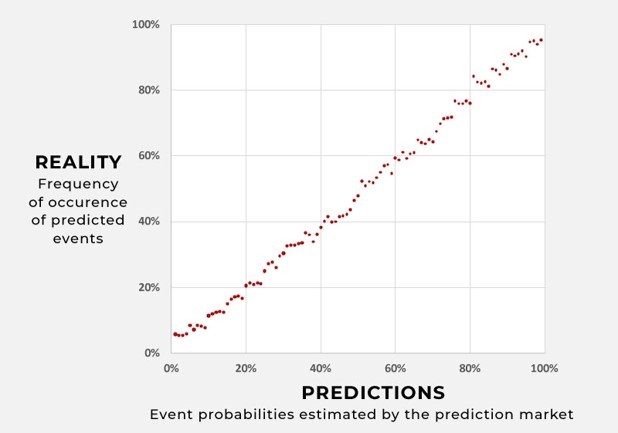
To verify prediction market accuracy, compare market probabilities against real-world outcomes after settlement. Use quantitative metrics like Mean Absolute Error (MAE) and Root Mean Squared Error (RMSE) to measure forecast errors. Benchmark against reputable sources like Bloomberg or the Federal Reserve, and consider the platform’s integrity (regulation, liquidity) when assessing accuracy.
- Compare market probabilities against real-world outcomes.
- Use quantitative metrics like Mean Absolute Error (MAE) and Root Mean Squared Error (RMSE).
- Benchmark against forecasts from reputable sources.
- Consider the platform’s integrity.
After an event settles, compare the market’s implied probability (based on the contract price) with what actually happened. For example, if a contract predicted a 70% chance of an event and it occurred, the market was accurate. If it didn’t, there was a prediction error.
These metrics can quantify the average error between the market’s predictions and the actual outcomes over a series of events. Lower MAE and RMSE values indicate higher accuracy. These metrics help to compare prediction market vs sports betting accuracy objectively.
Compare prediction market forecasts with those from established institutions like Bloomberg or the Federal Reserve. If the prediction market consistently outperforms these sources, it provides evidence of its accuracy and value.
Factors such as regulation and liquidity can affect a prediction market’s accuracy. A well-regulated market with high liquidity is more likely to reflect true probabilities due to greater participation and less manipulation. For example, platforms with high prediction market trading volume 2026 generally provide more reliable data.
Finding Undervalued Prediction Market Contracts: Spotting Opportunities in 2026
To find undervalued contracts, look for discrepancies between market probabilities and your own independent analysis. Focus on events with high uncertainty or low trading volume, and monitor news flow for potential catalysts that could shift market sentiment. Use AI tools to analyze price changes and liquidity to identify potential mispricings.
- Look for discrepancies between market probabilities and your own independent analysis.
- Focus on events with high uncertainty or low trading volume.
- Monitor news and information flow.
- Use AI tools to analyze price changes and liquidity.
If your analysis suggests a higher or lower probability than the market’s current price, it could indicate an undervalued or overvalued contract. This requires you to do your homework and form your own informed opinion, considering factors the market may be overlooking.
In these markets, prices are more likely to deviate from their true values due to a lack of information or participation. This creates opportunities for informed traders to capitalize on these inefficiencies. For example, consider crypto price prediction markets, which are often highly volatile.
Be alert for potential catalysts that could shift market sentiment. Breaking news, unexpected data releases, or significant political developments can all trigger rapid price movements. Being among the first to react to this information can give you a competitive advantage.
AI-powered tools can analyze vast amounts of data to identify patterns and anomalies that humans might miss. These tools can help you spot price changes, liquidity shifts, and other indicators of potential mispricings. Traders often seek how to make money on prediction markets by leveraging these tools.
Prediction Market Trading Taxes: What Beginners Need to Know for 2026
Prediction market gains are generally taxed as ordinary income in the US. It’s crucial to keep accurate records of all trades for tax reporting purposes. Consult a tax professional for personalized advice, as tax laws can be complex and vary depending on your individual circumstances.
- Prediction market gains are generally taxed as ordinary income in the US.
- Keep accurate records of all trades for tax reporting purposes.
- Consult a tax professional for personalized advice.
This means that any profits you make from trading on prediction markets are subject to the same tax rates as your salary or wages. This is a crucial consideration when evaluating the profitability of your trading activities.
You’ll need to track your buy and sell prices, dates, and the number of contracts traded. This information is essential for calculating your gains and losses and reporting them accurately on your tax return.
Tax laws can be complex and vary depending on your individual circumstances. A tax professional can provide guidance on how to properly report your prediction market gains and losses and minimize your tax liability. Remember to employ solid prediction market risk management techniques to minimize potential losses and tax implications.
Practical Takeaways for 2026
As you embark on your journey into prediction markets, remember that knowledge is your most valuable asset. Start small, focus on understanding the mechanics of the platforms, and always manage your risk. The integration of prediction markets into mainstream finance shows no signs of slowing down, potentially increasing opportunities to profit from predictions related to the Fed rate decision prediction market and other major events. By staying informed and disciplined, you can navigate these markets successfully.