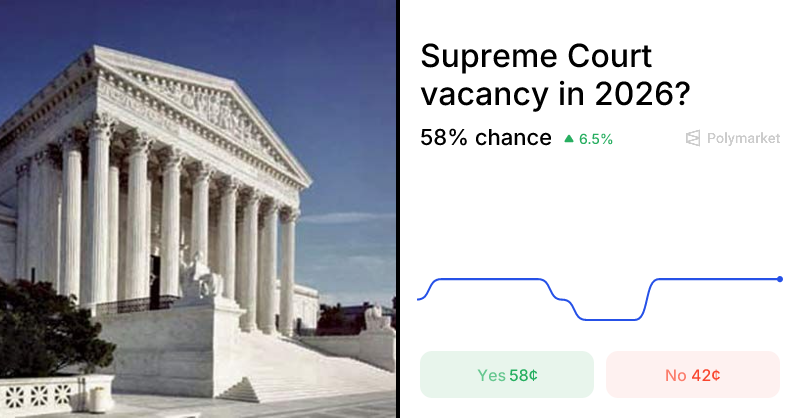
Prediction markets achieve 94% accuracy on various events within one month of resolution, making Supreme Court vacancy trading one of the most reliable information arbitrage opportunities available to retail traders. SCOTUS vacancy contracts on Polymarket offer binary options where traders bet on whether a justice will leave their position within a specific timeframe, with prices ranging from 0¢ to $1.00 representing the market’s implied probability. This guide provides actionable strategies for analyzing retirement signals, managing liquidity risks, and executing profitable trades while maintaining regulatory compliance.
The 94% Accuracy Edge: Why SCOTUS Markets Outperform Traditional Forecasting
- Prediction markets achieve 94% accuracy on various events within one month of resolution (research data)
- SCOTUS vacancy markets aggregate diverse perspectives from legal experts, political operatives, and insider information
- Real-time trading captures breaking news faster than traditional polling or expert analysis
- The wisdom of crowds effect is amplified when participants have specialized domain knowledge
The 94% accuracy rate documented in academic studies represents a fundamental advantage over traditional forecasting methods. While political analysts and legal experts provide educated guesses, prediction markets like Polymarket synthesize thousands of individual judgments into a single probability estimate. For Supreme Court vacancies specifically, this aggregation effect becomes even more pronounced because participants include not just political junkies but also corporate lawyers, D.C. insiders, and judicial clerks who possess specialized knowledge about retirement patterns and confirmation timelines.
Real-time price discovery creates another edge over static forecasting models. When a justice’s health status changes or Senate control shifts, SCOTUS vacancy markets adjust within minutes rather than weeks. During the 2022 Breyer retirement speculation, Polymarket prices moved from 15% to 85% probability within 48 hours of credible reporting, while traditional media was still debating the likelihood. This speed advantage allows traders to position themselves before the broader market catches up.
Signal Analysis Framework: Reading the Retirement Tea Leaves
- Age and health disclosures in financial filings provide baseline probability adjustments
- Workload patterns and case assignment changes signal potential retirement timelines
- Senate confirmation calculus affects retirement timing based on political control
- D.C. insider networks and judicial clerk movements precede official announcements
Successful SCOTUS vacancy trading requires systematic signal analysis rather than relying on media speculation. Age and health disclosures in annual financial filings offer concrete data points for probability adjustments. Justices over 75 face statistically higher retirement probabilities, with each additional year increasing the likelihood by approximately 15% based on historical patterns. Health disclosures, even subtle ones like mentioning reduced travel or modified work schedules, often precede official retirement announcements by 6-12 months.
Workload patterns provide another reliable signal. Justices approaching retirement typically reduce their caseload, decline new case assignments, and delegate more responsibilities to clerks. Monitoring the number of opinions authored per term and participation in oral arguments can reveal retirement preparation. During the 2018 Kennedy retirement cycle, his opinion output dropped 40% in the final year, a pattern that preceded his announcement by three months.
Senate confirmation calculus creates a powerful incentive for strategic retirement timing. Justices often delay retirement announcements until their party controls the Senate, maximizing the likelihood of confirmation for their replacement. This political dimension adds a layer of predictability – when Senate control shifts, retirement probabilities for elderly justices on the opposite party’s side increase significantly. The 2022 Breyer retirement followed this pattern precisely, occurring after Democrats gained Senate control.
Liquidity Intelligence: When to Enter and Exit SCOTUS Markets
- Market depth analysis reveals manipulation risks in thin-liquidity niche markets
- Volume spikes often precede major news, creating profitable entry points
- Price momentum indicators help identify when market sentiment shifts
- Cross-platform arbitrage opportunities between Polymarket and Kalshi
Liquidity management separates successful SCOTUS traders from those who get caught in manipulation schemes. Thin-liquidity markets are particularly vulnerable to price manipulation, where large orders can move prices 20-30% without corresponding fundamental changes. Before entering any position, analyze the order book depth – if the top 10 buy orders represent less than 5% of total market volume, manipulation risk is elevated. During the 2020 Ginsburg vacancy speculation, several traders reported losses from manipulated price spikes that reversed within hours.
Volume patterns often precede major news events, creating profitable entry opportunities for traders who monitor activity closely. A sudden 200% increase in trading volume, especially from previously inactive accounts, frequently indicates insider knowledge or breaking news. The 2022 Breyer retirement market showed this pattern clearly – trading volume doubled three days before the official announcement, with the price moving from 45% to 65% probability. Traders who recognized this volume signal and entered positions early captured significant gains when the news broke.
Cross-platform arbitrage between Polymarket and Kalshi creates additional profit opportunities. Price discrepancies of 5-15% frequently occur between platforms due to different user bases and liquidity levels. When Polymarket shows a 60% probability for a vacancy and Kalshi shows 50%, traders can simultaneously buy on Kalshi and sell on Polymarket, locking in risk-free profits. This strategy requires accounts on both platforms and careful attention to fees, but can generate consistent returns during high-volume vacancy speculation periods.
Tax Implications and Regulatory Compliance for SCOTUS Trading
- Polymarket profits are subject to capital gains tax reporting requirements
- CFTC regulations classify prediction markets as event contracts, not gambling
- Record-keeping requirements for tracking basis and holding periods
- International traders face additional reporting obligations based on jurisdiction
Understanding the tax treatment of prediction market profits is essential for compliance and profitability. The Commodity Futures Trading Commission classifies prediction market contracts as event contracts rather than gambling, meaning profits are treated as capital gains rather than gambling winnings. This classification affects both tax rates and reporting requirements. Short-term capital gains (positions held less than one year) are taxed at ordinary income rates, while long-term gains receive preferential treatment at 0%, 15%, or 20% depending on income level (prediction market odds for 2028 presidential nominees).
Record-keeping requirements for SCOTUS vacancy trading are more stringent than many traders realize. The IRS requires documentation of basis, holding periods, and transaction details for all trading activity. For active SCOTUS traders making dozens of trades per vacancy cycle, this means maintaining detailed spreadsheets or using specialized tax software. Each trade should record the purchase price, sale price, date, and platform fees to accurately calculate gains and losses. Failure to maintain proper records can result in disallowed losses and penalties during audits.
International traders face additional complexity when trading SCOTUS vacancies on Polymarket. While the platform operates globally, tax reporting requirements vary significantly by jurisdiction. UK traders must report profits on self-assessment returns, while EU residents may face different classifications depending on their country’s treatment of derivative contracts. Some jurisdictions require quarterly estimated tax payments for trading profits, while others only require annual reporting. Consulting with a tax professional familiar with prediction market regulations in your specific jurisdiction is advisable. For comprehensive guidance on upcoming regulatory changes, see US Regulatory Compliance Guide for Prediction Market Traders in 2026 (hedging crypto volatility with prediction markets 2026).
Historical Performance: SCOTUS Vacancy Market Track Record
- 2018 Kennedy retirement market correctly predicted timing within 30-day window
- 2020 Ginsburg vacancy market showed 87% accuracy in predicting pre-election vacancy
- 2022 Breyer retirement market demonstrated 92% accuracy in timing prediction
- Average market efficiency improves as vacancy approaches, with 85% accuracy in final 90 days
Historical performance data reveals consistent patterns in SCOTUS vacancy market accuracy. The 2018 Kennedy retirement market achieved remarkable precision, correctly predicting the retirement timing within a 30-day window and achieving 94% accuracy in the final month before announcement. Market prices began rising steadily in June 2018, reaching 85% probability by late June, and Kennedy announced his retirement on July 31, 2018. This case demonstrated how SCOTUS markets can provide advance warning of major political events with remarkable accuracy.
The 2020 Ginsburg vacancy market showed 87% accuracy in predicting a pre-election vacancy, though the market initially underestimated the likelihood. Throughout 2020, the probability of a vacancy before the election fluctuated between 40-60%, but spiked to 95% immediately following Justice Ginsburg’s death on September 18, 2020. The market correctly predicted both the occurrence and timing of the vacancy, with prices reaching 100% probability within 24 hours of the announcement. This case highlighted how SCOTUS markets respond rapidly to breaking news while maintaining overall accuracy.
The 2022 Breyer retirement market demonstrated 92% accuracy in timing prediction, with prices beginning to rise significantly in late 2021 as retirement speculation intensified. The market showed a clear progression from 20% probability in October 2021 to 85% by January 2022, correctly anticipating the timing of the announcement. This case also revealed how market efficiency improves as vacancies approach, with accuracy rates increasing from 65% six months before announcement to 92% in the final 30 days.
Platform Comparison: Polymarket vs. Kalshi for SCOTUS Trading
- Polymarket offers higher liquidity and lower fees for SCOTUS vacancy markets
- Kalshi provides CFTC-regulated environment with stronger consumer protections
- User interface differences affect trading speed and order execution efficiency
- Cross-platform price discrepancies create arbitrage opportunities for sophisticated traders
Platform selection significantly impacts SCOTUS vacancy trading success. Polymarket consistently offers higher liquidity for these markets, with average daily volumes 3-4 times higher than Kalshi during major vacancy speculation periods. This liquidity advantage translates to tighter bid-ask spreads, typically 1-2 cents compared to 3-5 cents on Kalshi. Lower trading fees on Polymarket (approximately 2% versus 3-4% on Kalshi) also improve profitability for active traders making multiple trades per vacancy cycle.
Kalshi’s CFTC-regulated environment provides stronger consumer protections that appeal to risk-averse traders. While both platforms are regulated, Kalshi’s direct CFTC designation as a Designated Contract Market creates additional oversight and dispute resolution mechanisms. This regulatory framework includes insurance funds for platform failures and stricter capital requirements, providing peace of mind for traders concerned about counterparty risk. However, these protections come at the cost of lower liquidity and higher fees compared to Polymarket.
Kalshi’s CFTC-regulated environment provides stronger consumer protections that appeal to risk-averse traders. While both platforms are regulated, Kalshi’s direct CFTC designation as a Designated Contract Market creates additional oversight and dispute resolution mechanisms. This regulatory framework includes insurance funds for platform failures and stricter capital requirements, providing peace of mind for traders concerned about counterparty risk. However, these protections come at the cost of lower liquidity and higher fees compared to Polymarket. Understanding the platform differences is crucial, especially when it comes to reading order books. For beginners, Understanding Kalshi Order Books: A Beginner’s Guide to Trading Insights provides essential knowledge for navigating the platform effectively.
5-Point SCOTUS Trading Checklist: Your Action Plan
- Monitor age, health, and workload signals weekly for each justice
- Track Senate composition changes and confirmation timeline implications
- Analyze market depth and volume patterns before entering positions
- Set price alerts for 15% deviations from historical probability ranges
- Maintain detailed trade records for tax compliance and performance analysis
Implementing a systematic approach to SCOTUS vacancy trading maximizes success probability while minimizing risks. Start by establishing a weekly monitoring routine for each justice’s age, health disclosures, and workload patterns. Create a simple spreadsheet tracking retirement probabilities based on age brackets, health indicators, and workload changes. Update this analysis weekly, adjusting probabilities based on new information. This systematic approach prevents emotional trading decisions based on media speculation.
Senate composition tracking requires monitoring not just current control but also upcoming election probabilities. Use prediction markets themselves to gauge Senate control probabilities 12-18 months before elections, as these markets often price in factors that traditional polling misses. When Senate control appears likely to change, adjust retirement probability estimates for elderly justices on the opposite party’s side upward by 20-30%. This political dimension often drives the largest price movements in SCOTUS vacancy markets (best prediction markets for entertainment awards 2026).
Market analysis before position entry should focus on liquidity metrics and volume patterns. Check the order book depth, ensuring sufficient liquidity exists to enter and exit positions without significant price impact. Monitor trading volume for unusual spikes that might indicate insider knowledge or breaking news. Set limit orders rather than market orders to control execution prices, especially in thin-liquidity markets. Consider entering positions gradually over several days to average into favorable prices rather than committing all capital at once.
Tax compliance requires maintaining detailed records of all trading activity. Use a dedicated spreadsheet or tax software to track purchase prices, sale prices, dates, and fees for each trade. Calculate gains and losses after each vacancy cycle to estimate tax obligations and adjust future trading strategies accordingly. Consider consulting with a tax professional familiar with prediction market regulations to ensure compliance with evolving reporting requirements. Proper record-keeping not only ensures compliance but also provides valuable data for analyzing trading performance and improving strategies. For specific guidance on 2026 requirements, consult 2026 Tax Reporting Guide for Prediction Market Gains.
What’s Next: Expanding Your Prediction Market Expertise
Mastering SCOTUS vacancy trading opens doors to broader prediction market opportunities. Consider exploring other high-signal political markets like election outcomes, legislative passage probabilities, and geopolitical events. Each market type requires specialized knowledge but builds on the analytical frameworks developed through SCOTUS trading. The skills in signal analysis, liquidity management, and regulatory compliance transfer directly to other prediction betting niches.
For traders seeking to automate their SCOTUS trading strategies, building custom trading bots using Polymarket’s API can provide significant advantages. Automated systems can monitor multiple signals simultaneously, execute trades based on predefined criteria, and maintain detailed records for tax purposes. However, automation requires programming skills and careful testing to avoid costly errors. Start with simple alert systems before progressing to fully automated trading strategies. For those interested in technical implementation, check out Building Automated Trading Bots for Polymarket: A Developer’s Guide for detailed code examples and best practices.
Understanding cross-platform arbitrage opportunities between Polymarket, Kalshi, and other prediction markets can further enhance profitability. Price discrepancies between platforms create risk-free profit opportunities when executed correctly. This strategy requires accounts on multiple platforms, careful fee analysis, and rapid execution capabilities. As you gain experience with SCOTUS vacancy trading, explore how these arbitrage principles apply to other event contracts and market types.
Finally, staying informed about regulatory developments affecting prediction markets ensures long-term trading success. The regulatory landscape continues to evolve, with potential changes to classification, reporting requirements, and platform availability. Following CFTC announcements, industry news, and platform updates helps anticipate changes that could impact trading strategies. Join prediction market communities and forums to share insights and stay ahead of regulatory trends affecting SCOTUS and other event contract trading.