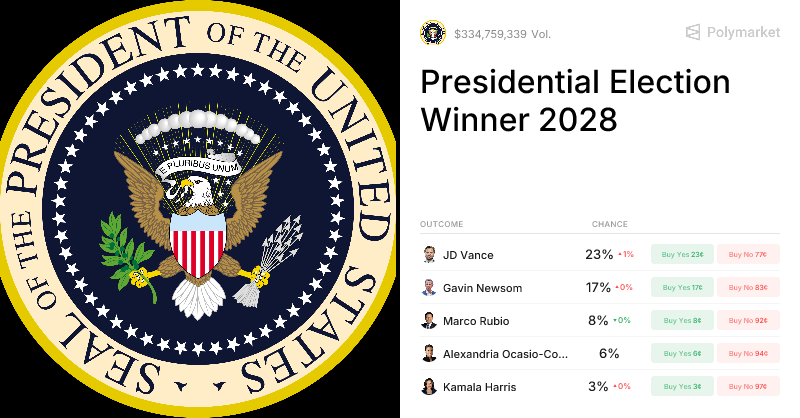
The 2028 US election prediction markets are already active with $64 billion in monthly trading volumes, offering unprecedented opportunities for early-position traders. But navigating these markets requires more than just political intuition—it demands a mathematical framework for position sizing and a clear understanding of platform differences that can make or break your capital efficiency. For those interested in expanding beyond traditional political markets, specialized contracts like Livermorium Price Prediction Markets offer unique trading opportunities in emerging asset classes.
How to Calculate Your Optimal Position Size for 2028 Election Markets Using the Kelly Criterion
The Kelly Criterion provides the mathematically optimal position sizing formula for binary political markets: f* = (bp – q) / b, where f* represents the Kelly fraction, p is your estimated true probability, q equals (1-p), and b denotes the net odds. This framework transforms subjective political analysis into quantifiable risk management, allowing traders to size positions based on edge rather than emotion.
Consider a practical application: if you estimate a candidate has a 60% true probability of winning while the market prices them at $0.40, the Kelly calculation yields a 33% position size. This means allocating 33% of your prediction market capital to that specific contract. However, real-world trading rarely uses full Kelly due to volatility concerns. Traders typically employ fractional Kelly strategies—Half Kelly (50% of the calculated fraction) for moderate risk tolerance or Quarter Kelly (25%) for conservative approaches.
The position sizing levels table below illustrates the risk-return trade-offs across different Kelly fractions:
| Level | Risk Profile | Strategy | Drawdown |
|---|---|---|---|
| Full | Very Aggressive | 100% of Formula | High (~50%+) |
| Half | Moderate | 50% of Formula | Moderate |
| Quarter | Conservative | 25% of Formula | Low/Controlled |
Binary political markets offer unique advantages for Kelly optimization. Unlike sports betting or financial markets, election outcomes are binary with clear settlement criteria, eliminating ambiguity in resolution. The mathematical precision of political forecasting models combined with market pricing creates opportunities for systematic traders who can identify and exploit mispriced probabilities before they correct.
Margin Requirements and Capital Efficiency: Kalshi vs. Polymarket Comparison
Kalshi requires 100% collateralization with no leverage, while Polymarket offers 5x capital efficiency through crypto collateral but carries counterparty risk. This fundamental difference in margin requirements creates vastly different capital efficiency profiles for traders with identical position sizes and risk tolerances.
Kalshi’s specifications include a $0.01 tick size, CFTC regulation, $9.5 billion monthly volumes, and fully collateralized positions. The platform’s predefined settlement sources and strict regulatory compliance provide certainty but limit capital efficiency. A $10,000 position on Kalshi requires the full $10,000 in collateral, leaving no room for leverage or capital recycling.
Polymarket specifications reveal a different approach: 4 decimal point precision, decentralized structure, $64 billion monthly volumes, and leveraged positions via crypto collateral. The platform’s community resolution mechanism and blockchain-based settlement enable capital efficiency that regulated exchanges cannot match. That same $10,000 position requires only $2,000 in collateral when using 5x leverage, freeing up $8,000 for other opportunities.
The capital efficiency calculation demonstrates the mathematical impact: Kalshi’s fully collateralized model means your capital is tied up until settlement, while Polymarket’s leverage model allows you to deploy the same capital across multiple positions or markets. However, this efficiency comes with increased counterparty risk—if Polymarket faces regulatory challenges or technical issues, leveraged positions could face liquidation or settlement delays (Bitcoin halving impact prediction markets).
Trading Mechanics and Order Types for Election Futures
Kalshi’s Central Limit Order Book (CLOB) provides traditional market structure with off-chain components, while Polymarket’s automated market maker (AMM) uses smart contracts to facilitate trades. These structural differences affect order execution, available order types, and overall trading experience.
Available order types vary significantly between platforms. Kalshi offers limit orders, market orders, stop-loss orders, and conditional orders with traditional market mechanics. Polymarket primarily uses market orders through its AMM, though limit orders are emerging through third-party integrations. The settlement procedures also differ: Kalshi uses predefined official sources with strict CFTC compliance timelines, while Polymarket relies on community consensus and smart contract automation, enabling faster settlements but introducing resolution uncertainty.
Liquidity considerations become critical for position sizing. Kalshi maintains $400 million in open interest with relatively stable liquidity across major markets. Polymarket’s liquidity varies significantly by market, with some contracts having deep liquidity while others face slippage issues. The $400 million open interest figure represents the total capital committed across all markets, but individual contract liquidity can differ substantially from this aggregate number.
Early-Cycle Liquidity Risk Management for 2028 Markets
Early-cycle markets require 25-50% smaller position sizes than mature markets due to higher slippage and whale impact potential. The 2028 election cycle, despite being over two years from the actual election, already exhibits these early-cycle characteristics with $64 billion in monthly volumes but variable liquidity across individual markets (S&P 500 year end price prediction market 2026).
Liquidity measurement metrics provide objective frameworks for risk assessment. Open interest represents the total number of outstanding contracts, while daily volume indicates market activity levels. Bid-ask spread analysis reveals the cost of entering and exiting positions—wider spreads indicate higher liquidity risk. A practical rule: wait for 30-day volume to exceed $1 million before committing significant capital to individual markets.
Whale impact assessment becomes crucial in early-cycle markets. A single trade moving odds by 10% or more indicates high liquidity risk and potential for manipulation. This phenomenon occurs when large traders or coordinated groups can significantly impact market prices due to limited liquidity. Position sizing must account for this risk by reducing normal Kelly fractions by an additional 25-50% in markets showing whale impact characteristics (Ethereum ETF approval odds prediction market).
Portfolio Construction for Political Prediction Markets
Correlation management requires portfolio-level risk adjustment when trading related events. Primary elections, general election outcomes, and related geopolitical events often exhibit correlation that can amplify portfolio risk beyond individual position sizing calculations. A candidate winning their primary may affect their general election odds, creating correlation that traditional position sizing doesn’t account for.
Diversification strategies spread risk across multiple candidates and related events. Rather than concentrating on a single candidate, successful traders allocate capital across multiple positions with different correlation profiles. This approach reduces the impact of any single market moving against your positions while maintaining exposure to the overall election cycle.
Risk budgeting allocates 10-15% of total prediction market capital to early-cycle political futures. This percentage reflects the higher risk profile of early-cycle markets while providing meaningful exposure to potential opportunities. The remaining capital stays in more liquid, mature markets or alternative prediction market categories (prediction market oganesson price futures markets).
Rebalancing triggers adjust positions when market probability changes exceed 15%. This threshold represents a significant enough move to warrant position adjustment while avoiding overtrading on minor price fluctuations. The 15% trigger also aligns with typical bid-ask spreads in liquid prediction markets, ensuring rebalancing costs don’t erode returns (prediction market tennessine price contracts).
Step-by-Step Position Sizing Framework for Early-Cycle Political Futures
Start with Quarter Kelly (25% of formula) for early-cycle markets, increase to Half Kelly as liquidity matures, and only use Full Kelly for highly liquid, well-established markets. This graduated approach accounts for the evolving risk profile of political prediction markets as they move from early-cycle to mature status (prediction market odds for US recession 2026).
The four-step sizing process begins with estimating true probability based on political analysis, polling data, and market fundamentals. Next, calculate the Kelly fraction using the formula f* = (bp – q) / b. Apply a liquidity adjustment factor of 0.25-0.5 for early-cycle markets, reducing the calculated Kelly fraction. Finally, set stop-loss at 2x position size to limit downside risk while allowing for normal market volatility.
Dynamic sizing adjustment recalculates position size weekly as market probabilities and liquidity change. This ongoing process ensures position sizes remain optimal as market conditions evolve. Weekly recalculation strikes a balance between responsiveness to market changes and avoiding overtrading based on short-term noise.
Portfolio-level risk limits cap maximum exposure at 5% of total capital per individual political event. This limit prevents any single market from dominating portfolio risk while allowing meaningful position sizes. The 5% cap also provides a buffer against correlation risk when trading related political events.
Which Platform Should You Start With? Platform Selection Guide
Choose Kalshi for capital preservation and regulatory certainty, or Polymarket for capital efficiency and higher potential returns, based on your risk tolerance and trading experience. This fundamental decision shapes your entire trading approach and risk profile.
Risk tolerance assessment determines platform selection. Conservative traders who prioritize capital preservation and regulatory certainty should choose Kalshi’s CFTC-regulated environment. Aggressive traders seeking capital efficiency and higher potential returns may prefer Polymarket’s leveraged model. Mixed approach traders can utilize both platforms, allocating capital based on specific market opportunities and risk profiles.
Capital requirements comparison reveals significant differences. Kalshi requires $10,000 minimum for meaningful positions due to its fully collateralized model, while Polymarket allows similar exposure with $2,000 in capital when using 5x leverage. This 5x difference in capital efficiency can be decisive for traders with limited capital or those seeking to diversify across multiple markets.
Experience level considerations affect platform mechanics. Beginners benefit from Kalshi’s simpler mechanics, traditional order types, and regulatory certainty. The platform’s CLOB structure and standard trading interface resemble traditional financial markets, reducing the learning curve. Experienced traders may prefer Polymarket’s advanced features, including leverage, decentralized settlement, and global access, though these features require deeper understanding of crypto mechanics and counterparty risk.
Platform selection ultimately depends on your trading objectives, risk tolerance, and capital constraints. The mathematical framework provided by the Kelly Criterion remains constant across platforms, but the practical implementation differs significantly based on margin requirements, liquidity profiles, and regulatory environments.