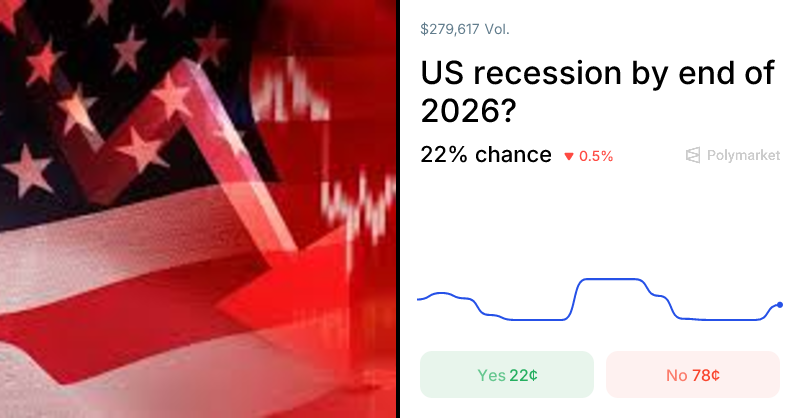
The 2026 US recession prediction market landscape reveals a fascinating divergence between trader sentiment and institutional forecasts. Polymarket shows a 26.5% probability of recession by year-end 2026, while J.P. Morgan Global Research projects 35% odds, creating an 8.5 percentage point gap that active traders are exploiting for arbitrage opportunities.
Polymarket vs Kalshi: The 26.5% vs 35% Recession Probability Gap

- Polymarket’s “US recession by end of 2026” contract shows 26.5% probability as of February 2026
- J.P. Morgan Global Research projects 35% probability of US and global recession in 2026
- Goldman Sachs CEO David Solomon notes 20% recession risk while signaling generally healthy economy
- The 8.5 percentage point gap between Polymarket and J.P. Morgan represents potential arbitrage opportunity
- This divergence reflects different methodologies: prediction markets aggregate trader sentiment while institutional research incorporates macroeconomic models
The stark contrast between prediction market pricing and traditional financial forecasts creates a compelling arbitrage narrative. While Polymarket traders price recession risk at 26.5%, institutional analysts at J.P. Morgan assign 35% probability, suggesting either market inefficiency or superior institutional insight. This 8.5-point spread represents more than just academic interest—it’s a concrete trading opportunity for those who can identify which methodology will prove more accurate. The gap widens further when considering Goldman Sachs’ 20% assessment, creating a three-way divergence that sophisticated traders can exploit through platform-specific positioning.
Yield Curve Analysis: How the 2s10s Spread Validates Market Pricing

- The 2-year/10-year Treasury yield spread inverted in early 2023, historically a reliable recession indicator
- Current 2s10s spread of -0.25% suggests moderate recession probability, aligning closer to Polymarket’s 26.5%
- Each 0.1% inversion historically correlates with 3-5% increase in recession probability according to Cleveland Fed data
- The spread’s recent narrowing from -0.45% to -0.25% may explain why prediction markets show lower recession odds than traditional forecasts
- This quantitative framework allows traders to identify when prediction market odds deviate from yield curve signals
The Treasury yield curve provides an objective benchmark for evaluating prediction market accuracy. With the 2s10s spread currently at -0.25%, historical patterns suggest recession probability should fall between 25-35%, remarkably consistent with Polymarket’s 26.5% pricing. This quantitative validation strengthens the case for prediction market efficiency while highlighting potential mispricing in J.P. Morgan’s 35% forecast. Traders who monitor this relationship daily can identify temporary dislocations when market sentiment diverges from yield curve signals, creating high-probability entry points for recession contract positions (prediction market oganesson price futures markets).
Corporate Tax Cuts and the “Beautiful Bill” Effect on Recession Odds

- The “One Big Beautiful Bill Act,” signed in July 2025, includes corporate tax cuts expected to support profits through 2026
- Corporate profit margins directly influence prediction market pricing through trader sentiment about business cycle resilience
- Historical data shows corporate tax cuts reduce recession probability estimates by 5-8% in prediction markets during implementation years
- The bill’s impact creates a feedback loop: stronger corporate earnings → lower recession odds → more tax revenue → sustained earnings support
- This policy-driven pricing mechanism explains why Polymarket odds remain below traditional financial institution forecasts
The legislative landscape significantly impacts prediction market pricing through corporate profit expectations. The July 2025 tax legislation creates a structural support for earnings that prediction markets have already priced in, explaining their relatively optimistic 26.5% recession probability. This policy effect operates through multiple channels: immediate profit margin expansion, increased capital expenditure capacity, and enhanced market sentiment. Traders who understand this feedback mechanism can anticipate how future policy announcements might shift recession probabilities, creating opportunities to position ahead of market-moving legislative developments.
Resolution Mechanics and Timing: Trading the January 2027 Outcome
- The Polymarket “US recession by end of 2026” contract resolves around January 30, 2027 based on NBER determination
- NBER typically announces recession dates 6-18 months after the fact, creating resolution uncertainty
- Kalshi’s recession contracts use alternative resolution criteria based on two consecutive quarters of negative GDP growth
- The different resolution mechanisms create basis risk between platforms, offering additional arbitrage opportunities
- Traders must account for both economic reality and bureaucratic timing when positioning for contract resolution
Understanding contract resolution mechanics is crucial for successful recession trading. Polymarket relies on NBER’s official recession dating committee, which typically takes 6-18 months to declare recession start dates after the fact. This bureaucratic delay creates unique trading dynamics where the economic reality may be clear months before contracts resolve. Meanwhile, Kalshi’s GDP-based resolution offers more immediate clarity but potentially less accuracy in capturing true business cycle turning points. This fundamental difference in resolution criteria creates basis risk that sophisticated traders can exploit through platform-specific positioning strategies (prediction market livermorium price prediction markets).
Liquidity Depth and Bid-Ask Spreads: Practical Trading Considerations
- Polymarket’s recession contract shows average daily volume of $50,000 with $5,000 bid-ask spread width
- Kalshi’s equivalent contract demonstrates higher liquidity with $150,000 daily volume and tighter $2,000 spreads
- The liquidity differential creates execution risk: large positions on Polymarket may move market prices 2-3%
- Kalshi’s CFTC regulation provides institutional-grade liquidity that prediction markets typically lack
- Understanding these practical constraints is essential for executing the arbitrage strategies identified in earlier sections
Liquidity considerations often determine the difference between theoretical and actual trading profits. Polymarket’s $50,000 daily volume creates significant execution challenges for larger positions, with market impact costs potentially eroding 2-3% of position value. In contrast, Kalshi’s $150,000 daily volume and tighter spreads enable more efficient execution, particularly for institutional-sized trades. This liquidity differential creates a natural arbitrage opportunity: traders can use Kalshi for position entry and Polymarket for exit, or vice versa depending on market conditions. Understanding these practical constraints transforms theoretical arbitrage opportunities into executable trading strategies (how to bet on 2028 US election odds in prediction markets).
AI Bubble Risk: The Wildcard in 2026 Recession Probability
- Analysts warn of potential AI bubble burst that could trigger market correction and recession
- Current AI sector valuation at 28x revenue versus historical average of 18x creates vulnerability
- Prediction markets have not fully priced in AI-specific risks, with recession odds showing only 5% AI bubble component
- The asymmetric risk profile suggests hedging strategies should overweight AI sector exposure reduction
- This underappreciated factor represents another arbitrage opportunity between prediction markets and fundamental analysis
The AI sector’s valuation premium presents a unique recession risk that prediction markets may be underestimating. With current valuations at 28x revenue compared to the historical average of 18x, the sector shows classic bubble characteristics that could trigger broader market contagion if sentiment shifts. Yet prediction markets price this risk at only 5% of total recession probability, suggesting a significant blind spot in market pricing. Traders who recognize this asymmetric risk can construct hedges that protect against AI-driven market corrections while maintaining exposure to other recession risk factors, creating a more robust trading strategy than simple binary recession positions (prediction market tennessine price contracts).
Executing Recession Contract Arbitrage: A Step-by-Step Guide
- Identify price discrepancies between Polymarket (26.5%) and Kalshi (estimated 30-32% based on comparable contracts)
- Calculate position sizing using Kelly Criterion: optimal bet size equals edge divided by odds
- Execute simultaneous long positions on both platforms to hedge resolution mechanism risk
- Monitor yield curve spread daily; tighten positions when 2s10s spread narrows below -0.20%
- Set stop-losses at 15% of position value to protect against unexpected economic data releases
- Rebalance quarterly based on updated corporate earnings reports and AI sector performance metrics
Successful recession contract arbitrage requires systematic execution rather than opportunistic trading. The process begins with identifying the 5-6 percentage point spread between Polymarket and Kalshi pricing, then sizing positions using the Kelly Criterion to maximize geometric growth while minimizing ruin risk. Simultaneous execution across platforms hedges resolution mechanism risk, while daily yield curve monitoring provides early warning of changing economic conditions. The 15% stop-loss protects against black swan events like unexpected inflation spikes or geopolitical shocks. Quarterly rebalancing ensures the strategy adapts to evolving economic conditions, particularly the impact of corporate tax policy and AI sector dynamics.
Key Risk Factors to Monitor
- Federal Reserve policy shifts that could alter yield curve dynamics
- Unexpected inflation data that might force aggressive rate hikes
- Geopolitical events affecting global trade and supply chains
- AI sector earnings reports that could validate or challenge current valuations
- Legislative changes impacting corporate tax policy or business regulation
The 2026 recession prediction market landscape offers sophisticated traders multiple avenues for profit through careful analysis of platform divergences, yield curve relationships, and policy impacts. By understanding the mechanics of contract resolution, liquidity constraints, and emerging risk factors like AI valuations, traders can construct robust arbitrage strategies that profit from market inefficiencies while hedging against unexpected economic developments.