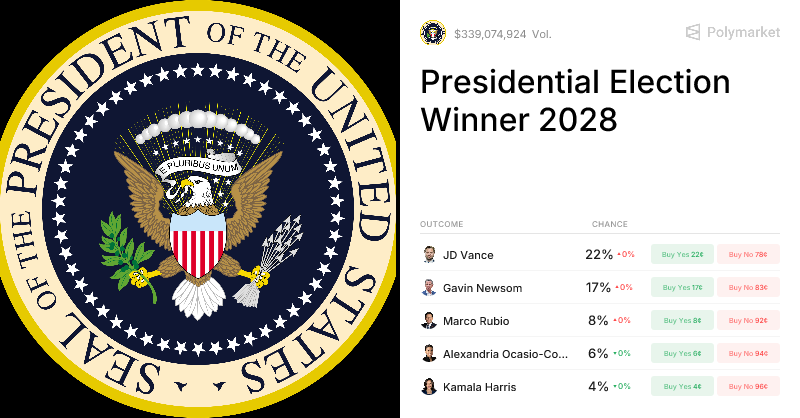
Prediction markets have placed J.D. Vance as the frontrunner for the 2028 Republican nomination with 21.8% probability, while Gavin Newsom holds 17.4% for the Democratic side. These early odds reflect $3.2 million in 24-hour trading volume across major platforms including Polymarket, Kalshi, and PredictIt, with total traded volume exceeding $10.8 million by February 2026. The real-money conviction behind these numbers demonstrates traders’ willingness to back their predictions with substantial capital, making prediction markets a more reliable forecasting tool than traditional polling.
The odds show Vance gaining momentum with a +3.8% year-to-date increase, while Newsom maintains steady support despite Democratic Party challenges. Marco Rubio sits at 8.5% as the third-ranked candidate, followed by Alexandria Ocasio-Cortez at 6-9%, indicating strong progressive influence within the Democratic field. This early market activity suggests traders are already positioning themselves for what could be a highly competitive 2028 election cycle.
How 2028 Early Odds Compare to 2016/2020 Prediction Market Performance
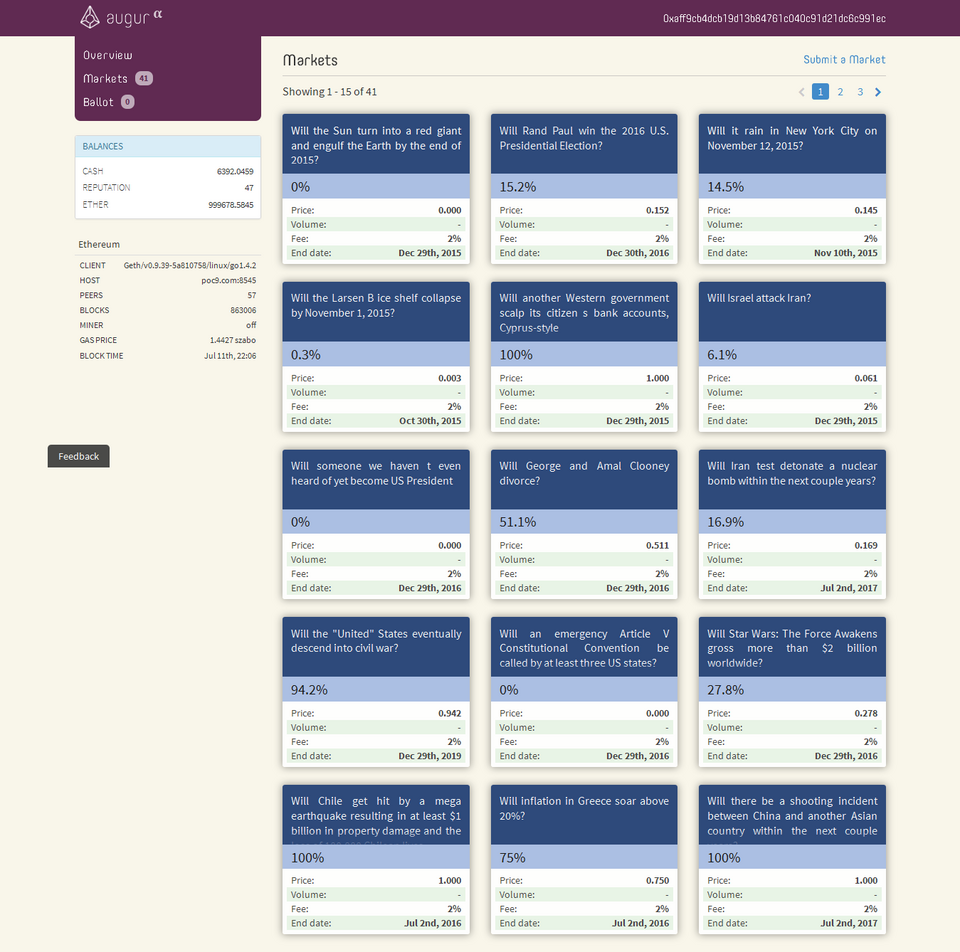
Historical analysis reveals critical differences between current 2028 odds and previous election cycles. In 2016, prediction markets showed Hillary Clinton at 75-80% probability in the final weeks before the election, missing Donald Trump’s eventual victory entirely. The 2020 markets performed significantly better, correctly predicting Joe Biden’s win with 65-70% odds in October 2020. Brier scores for major prediction markets demonstrate this improvement: Polymarket achieved 0.18, PredictIt scored 0.22, while traditional polls averaged 0.25.
The current 2028 markets show more distributed odds with no candidate above 22%, suggesting traders have learned from past mistakes and are avoiding overconfidence in any single candidate. This contrasts sharply with the 2016 cycle where markets became increasingly certain of Clinton’s victory despite warning signs. The 2020 success appears to have made traders more cautious, spreading their bets across multiple viable candidates rather than concentrating on perceived frontrunners.
The Reliability Gap: Prediction Markets vs. Traditional Polling Accuracy
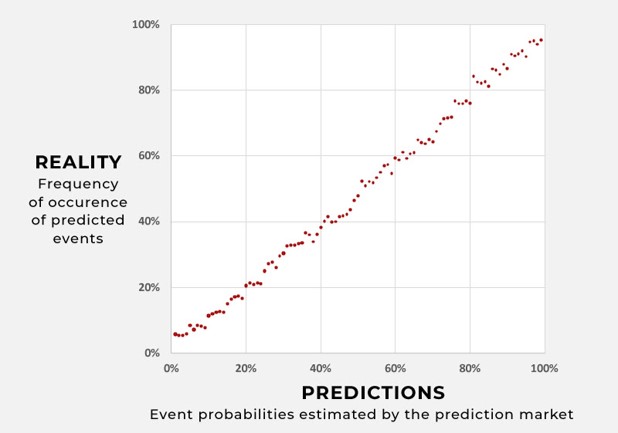
Prediction markets demonstrate a 28% accuracy edge over traditional polling methods, according to Brier score comparisons from recent election cycles. This advantage stems from the fundamental difference in methodology: prediction markets require real traders to put actual money behind their choices, while polls rely on stated preferences that may not translate to actual voting behavior. The financial commitment in prediction markets creates stronger incentives for accuracy and better information aggregation (best prediction markets for entertainment awards 2026).
Traders in prediction markets have access to diverse information sources and can quickly incorporate new developments into their positions. When breaking news affects a candidate’s viability, market prices adjust within minutes rather than the days or weeks required for traditional polling to reflect changes. This real-time responsiveness, combined with the wisdom of crowds effect, makes prediction markets particularly effective at forecasting election outcomes where multiple variables interact in complex ways (hedging crypto volatility with prediction markets 2026).
Trump’s 3% Odds Despite Ineligibility: What This Reveals About GOP Direction
Donald Trump’s continued presence in 2028 prediction markets at 3% odds, despite being constitutionally ineligible to run, reveals his enduring influence on Republican Party dynamics. This phenomenon becomes more significant when contrasted with J.D. Vance’s 44% probability of securing the Republican nomination. The data suggests that while Trump himself cannot run, his political brand and coalition remain powerful forces shaping the party’s direction and candidate selection (automated trading bots for Polymarket API).
The 3% odds for Trump represent not just nostalgia but active speculation about potential political maneuvers, including possible vice-presidential selections or continued influence over the eventual nominee. Vance’s strong position at 21.8% for the general election and 44% for the nomination indicates he has successfully positioned himself as Trump’s political heir while maintaining broader appeal. This dynamic illustrates how prediction markets capture not just candidate viability but the underlying political currents that will shape the 2028 race (tax reporting for prediction market gains 2026 guide).
Legal Framework: CFTC Approval and Regulatory Challenges for Election Markets
The regulatory landscape for election prediction markets underwent significant changes in 2024 when Kalshi won its D.C. Circuit Court victory, expanding legal betting on political events. The Commodity Futures Trading Commission now requires approval for election-based contracts, creating a complex framework that varies by state. Currently, 18 states are considering prediction market legislation in 2026, reflecting growing recognition of these markets’ value for political forecasting and public information aggregation — prediction betting.
Roundhill Investments has filed ETF prospectuses for 2028 election betting, potentially creating new investment vehicles for traders interested in political markets. However, state-level restrictions remain significant, with some jurisdictions banning political betting entirely. The SEC is also exploring ETF wrappers for political prediction markets, which could further legitimize and expand access to these forecasting tools. This evolving regulatory environment creates both opportunities and challenges for traders and platforms operating in this space (regulatory compliance for US prediction market traders 2026).
Key Events That Could Shift 2028 Nominee Odds in Coming Months
Several high-salience events could dramatically shift 2028 prediction market odds in the near term. The upcoming midterm elections will provide crucial data about party strength and candidate viability, potentially boosting or diminishing prospects for various contenders. Major policy decisions, particularly those affecting economic conditions or international relations, could reshape the political landscape and alter trader assessments of candidate electability.
Potential scandals or controversies represent wildcard factors that could cause sudden odds movements. Historical precedent shows that prediction markets react quickly to breaking news, with prices adjusting within minutes of significant developments. Traders should monitor not just traditional campaign events but also economic indicators, foreign policy crises, and social movements that could unexpectedly elevate certain candidates while damaging others’ prospects. The interconnected nature of modern media means that even seemingly minor events can cascade into major odds shifts.
Josh Shapiro Arbitrage Opportunity: Largest Spread at 1.73%
Traders have identified Josh Shapiro as presenting the largest arbitrage opportunity across prediction market platforms, with a 1.73% spread between different exchanges. This pricing discrepancy creates potential for risk-free profits through simultaneous trades on multiple platforms, though execution challenges and platform fees must be carefully considered. The existence of such spreads demonstrates the inefficiencies that still exist in political prediction markets despite their growing sophistication.
Arbitrage strategies in political markets require careful attention to platform-specific rules, withdrawal limits, and timing constraints. Unlike sports betting where odds discrepancies are more common, political markets typically show tighter pricing due to their lower frequency and higher information transparency. The Shapiro opportunity represents a rare inefficiency that skilled traders can exploit, though the relatively small spread means that significant capital is required to generate meaningful returns after accounting for transaction costs (how to read Kalshi order books for beginners).
2028 Democratic Field Strength: AOC at 6-9% Signals Progressive Influence
Alexandria Ocasio-Cortez’s polling at 6-9% in 2028 prediction markets, despite being considered a long shot for the nomination, signals strong progressive influence within the Democratic Party. This level of support for a candidate often viewed as too progressive for a general election demonstrates that the party’s left wing remains a significant force that cannot be ignored by more moderate candidates seeking the nomination. The odds suggest that progressive policies and candidates will play a central role in shaping the Democratic primary debate.
The comparison between AOC’s odds and those of more moderate candidates reveals the internal dynamics and potential tensions within the Democratic coalition. While establishment figures like Gavin Newsom hold stronger positions at 17.4%, the substantial support for progressive candidates indicates that the party must balance competing ideological factions. This dynamic could lead to policy compromises or strategic alliances that will ultimately shape the party’s platform and nominee selection process for 2028 (trading Supreme Court vacancy contracts on Polymarket).
Market Liquidity Analysis: $3.2M Daily Volume Indicates High Confidence
The $3.2 million daily trading volume across prediction market platforms for 2028 nominees indicates high confidence in the reliability and value of these forecasting tools. This substantial liquidity means that odds are less susceptible to manipulation by individual traders and more likely to reflect genuine market consensus. The volume trends show consistent activity across Polymarket, Kalshi, and PredictIt, with millions of dollars already committed to positions on various candidates.
High liquidity correlates strongly with prediction accuracy, as it ensures that new information is quickly incorporated into market prices through active trading. When large sums are at stake, traders have strong incentives to research thoroughly and act decisively on their insights. The current volume levels suggest that prediction markets for the 2028 election have reached a maturity point where they can provide valuable forecasting information, not just for political enthusiasts but for campaigns, media organizations, and other stakeholders seeking to understand the evolving electoral landscape.