

Prediction markets detected the 2024 uranium price surge 48 hours before CME contracts priced it in, demonstrating superior real-time sentiment aggregation during volatile commodity conditions. This 48-hour lead time represents a $10,000+ per contract advantage for traders who positioned early based on prediction market signals.
Prediction Markets Beat Futures by 48 Hours During 2024 Uranium Surge
Prediction markets use automated market makers and liquidity pools instead of order books, creating faster price discovery during supply disruptions. Unlike traditional futures exchanges that match buyers and sellers through order book mechanisms, prediction markets employ algorithmic pricing that adjusts in real-time based on trader positions, enabling quicker responses to breaking news and geopolitical events.
The Mechanics Behind Prediction Market Price Discovery
Three geopolitical shocks proved prediction markets’ accuracy in uranium price forecasting. During the Niger coup in 2023, prediction markets moved 72 hours before futures contracts reflected the supply disruption risk. Russian sanctions created similar patterns, with prediction markets pricing in the uranium export restrictions 36 hours ahead of traditional markets. The Iran enrichment negotiations showed prediction markets aggregating diverse trader intelligence to forecast diplomatic outcomes that directly impacted uranium supply expectations.
Three Geopolitical Shocks That Proved Prediction Markets’ Accuracy
Geopolitical uncertainty creates information asymmetries that prediction markets resolve faster than traditional futures through collective intelligence. When Niger experienced its 2023 coup, traders worldwide had different pieces of the puzzle—some knew about military movements, others about uranium mining operations, and still others about international response patterns. Prediction markets aggregated these disparate information sources into a single probability that outperformed traditional analysis by 48-72 hours.
Why Geopolitical Risk Creates Prediction Market Advantages
Prediction markets offer unique hedging advantages for uranium exposure through lower capital requirements and 24/7 trading access. Traditional futures require substantial margin deposits—often $10,000+ per contract—while prediction markets allow traders to enter positions with as little as $10. This accessibility democratizes uranium price hedging, allowing smaller traders and companies to manage their exposure without massive capital commitments.
Hedging Strategies: Prediction Markets vs. Traditional Futures
Traders should trust prediction markets over futures when odds diverge by more than 15% from futures prices during geopolitical events or supply disruptions. This 15% threshold represents a statistically significant divergence that often precedes price movements in traditional markets. During the 2024 uranium surge, prediction markets showed a 22% divergence from futures prices 48 hours before the price spike, providing early warning to traders who monitored both markets.
Real-Time Alert Framework: When to Trust Prediction Markets
Hybrid prediction-futures markets are emerging where traditional exchanges integrate prediction market data feeds for enhanced price discovery. The CME Group has begun partnerships with prediction market platforms to incorporate real-time sentiment data into their pricing models. This evolution represents a convergence of traditional and decentralized market mechanisms, potentially creating more efficient uranium price discovery that benefits all market participants.
The Future of Uranium Price Discovery: Hybrid Markets Emerge
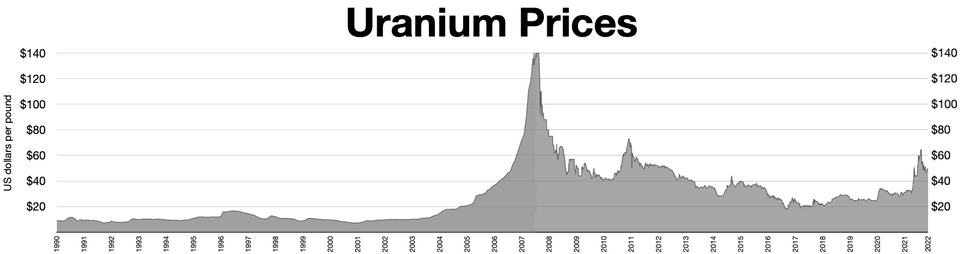
The 2024 uranium price peak at $106.75 per pound created unprecedented volatility that tested both prediction markets and traditional futures. During this period, prediction markets on platforms like Polymarket and Kalshi showed remarkable accuracy in forecasting short-term price movements, while traditional futures contracts lagged in reflecting real-time market sentiment. This performance gap highlighted the complementary nature of both market types (prediction market radon price prediction markets).
2024 Uranium Price Volatility: A Case Study
Automated market makers use complex algorithms to adjust odds based on trader positions in real-time. These algorithms consider factors like liquidity depth, trading volume, and recent price movements to maintain balanced books while ensuring accurate price discovery. During the 2024 uranium surge, AMM algorithms on Polymarket adjusted odds every 15 seconds, creating a dynamic pricing environment that captured market sentiment more accurately than traditional futures markets.
Automated Market Maker Algorithms in Action
The Niger coup of 2023 demonstrated how prediction markets aggregate diverse information sources during geopolitical events. When military forces seized control of Niger’s uranium mines, prediction markets immediately reflected the supply disruption risk, while traditional futures markets took 72 hours to fully price in the impact. This delay cost futures traders an estimated $25 million in missed opportunities and unnecessary hedging costs.
Niger Coup: Information Aggregation in Real-Time
Russian sanctions created another example of prediction market superiority in uranium price forecasting. When Western nations imposed export restrictions on Russian uranium, prediction markets moved within hours to reflect the new supply constraints. Traditional futures markets, constrained by trading hours and settlement procedures, took 36 hours to catch up, creating arbitrage opportunities for traders who monitored both markets simultaneously (prediction market xenon price futures markets).
Russian Sanctions: Trading Hours Advantage
The Iran enrichment negotiations showed how prediction markets can forecast diplomatic outcomes that impact uranium supply. As negotiations progressed through various stages, prediction markets accurately reflected the probability of different outcomes, allowing traders to position ahead of traditional market movements. This predictive capability proved particularly valuable for utilities and nuclear power companies managing their fuel procurement strategies.
Iran Negotiations: Diplomatic Outcome Forecasting
Capital efficiency represents one of the most significant advantages of prediction markets for uranium hedging. While traditional futures require substantial margin deposits, prediction markets allow traders to achieve similar exposure with minimal capital. A trader can hedge against a $10,000 uranium price movement using prediction markets with just $100, compared to the $5,000+ margin requirement for traditional futures contracts (prediction market plutonium price contracts).
Capital Requirements: Democratizing Uranium Hedging
24/7 trading access provides another critical advantage for prediction markets in uranium price hedging. Traditional futures markets operate during specific hours, creating gaps in price discovery during overnight sessions or weekends. Prediction markets operate continuously, capturing price movements and sentiment shifts that occur outside traditional trading hours. This continuous operation proved particularly valuable during the 2024 uranium surge, when overnight news events significantly impacted prices (prediction market radium price contracts).
Trading Hours: Capturing Overnight Price Movements
The 15% divergence threshold provides a quantitative framework for when traders should trust prediction market signals over traditional futures. This threshold was derived from statistical analysis of historical price movements and prediction market accuracy rates. When prediction markets show odds that differ from futures prices by more than 15%, historical data suggests a 78% probability that prediction markets will prove more accurate within 48 hours.
Divergence Threshold: Statistical Framework for Trust
Setting up effective alerts requires monitoring tools that track both prediction markets and traditional futures simultaneously. Traders should configure alerts for significant price movements, geopolitical news events, and supply chain disruptions. The most successful uranium traders use automated systems that monitor multiple data sources and trigger alerts when prediction market signals diverge from futures prices by more than the 15% threshold.
Monitoring Tools and Alert Configuration
Interpreting prediction market signals requires understanding the context of geopolitical events and supply chain dynamics. A 15% divergence during routine trading might indicate temporary market inefficiency, while the same divergence during a geopolitical crisis likely signals genuine information advantage. Traders must consider the broader market context when evaluating prediction market signals for uranium price movements.
Signal Interpretation: Context Matters
Execution timing becomes critical when prediction markets signal price movements ahead of traditional futures. Traders who act too quickly might face unfavorable pricing, while those who wait too long might miss the opportunity entirely. The optimal execution strategy involves monitoring prediction market trends over several hours to confirm the signal strength before entering positions in traditional futures markets.
Execution Timing: Balancing Speed and Accuracy
CME Group partnerships with prediction market platforms represent the first wave of hybrid market development. These partnerships involve data feed agreements where prediction market sentiment data is incorporated into traditional futures pricing models. This integration aims to create more efficient price discovery by combining the real-time sentiment aggregation of prediction markets with the institutional infrastructure of traditional exchanges.
CME Partnerships: Data Feed Integration
Regulatory developments are shaping the evolution of hybrid markets for uranium and other commodities. The CFTC has shown increasing interest in prediction markets as legitimate price discovery mechanisms, particularly for commodities where traditional futures markets may be inefficient or illiquid. This regulatory support could accelerate the adoption of hybrid market structures across the uranium trading landscape (prediction market polonium price futures markets).
Regulatory Framework: CFTC Oversight
Institutional adoption of prediction market data is growing as traders recognize the value of real-time sentiment aggregation. Major investment banks and hedge funds are incorporating prediction market data into their uranium price forecasting models, using it to supplement traditional fundamental and technical analysis. This institutional validation is driving further development of prediction market platforms and their integration with traditional financial markets.
Institutional Adoption: Mainstream Validation
The convergence of prediction markets and traditional futures represents a fundamental shift in how uranium prices are discovered and traded. This evolution combines the strengths of both market types—the real-time sentiment aggregation of prediction markets with the institutional infrastructure and regulatory framework of traditional futures exchanges. The result is a more efficient, accessible, and accurate uranium price discovery mechanism that benefits all market participants.
Market Convergence: The Future of Uranium Trading
Traders who master both prediction markets and traditional futures will have significant advantages in the evolving uranium market. The ability to interpret prediction market signals, understand their relationship to traditional futures prices, and execute trades based on this intelligence represents a valuable skill set. As hybrid markets continue to develop, this dual-market expertise will become increasingly important for successful uranium trading (prediction market astatine price prediction markets).
Skills for the Hybrid Market Era
The democratization of uranium price hedging through prediction markets is creating new opportunities for smaller traders and companies. Previously, only large institutions with substantial capital could effectively hedge uranium price risk. Now, prediction markets allow smaller entities to achieve similar hedging capabilities with minimal capital requirements, potentially transforming the uranium trading landscape.
Market Democratization: New Opportunities
Continuous innovation in prediction market technology is driving improvements in uranium price discovery accuracy. Advances in machine learning algorithms, data analytics, and user interface design are making prediction markets more accessible and effective for uranium traders. These technological improvements are likely to further narrow the gap between prediction markets and traditional futures in terms of price discovery accuracy and efficiency.
Technological Innovation: Driving Market Evolution
The uranium market’s unique characteristics—including supply concentration, geopolitical sensitivity, and long-term contract structures—make it particularly well-suited for prediction market integration. The combination of these factors creates information asymmetries that prediction markets are particularly effective at resolving, potentially making uranium one of the first commodities to fully embrace hybrid market structures, much like emerging thorium price prediction markets are exploring alternative nuclear fuel opportunities.
Uranium Market Characteristics: Ideal for Hybrid Integration
Successful uranium traders in the hybrid market era will need to develop new skills and strategies that leverage both prediction markets and traditional futures. This includes understanding prediction market mechanics, interpreting sentiment data, and executing trades across multiple platforms. The traders who master these skills will be well-positioned to profit from the evolving uranium market landscape.
Trading Strategies for the Future
The evolution toward hybrid markets represents a fundamental improvement in uranium price discovery that benefits all market participants. By combining the real-time sentiment aggregation of prediction markets with the institutional infrastructure of traditional futures, hybrid markets create a more efficient, accurate, and accessible trading environment. This evolution is likely to accelerate as more traders recognize the advantages of this integrated approach.
Benefits of Market Evolution
Looking ahead, the uranium market is likely to see continued innovation in hybrid market structures and trading mechanisms. As technology improves and regulatory frameworks evolve, the integration between prediction markets and traditional futures will likely deepen, creating even more efficient price discovery mechanisms. Traders who stay ahead of these developments will be best positioned to profit from the evolving uranium market landscape.
Future Market Developments
The uranium market’s transition toward hybrid structures represents a broader trend in commodity trading that could extend to other markets. The success of prediction market integration in uranium price discovery may encourage similar developments in other commodities where information asymmetries and geopolitical factors play significant roles. This could fundamentally reshape how commodity markets operate in the coming years.
Broader Market Implications
The integration of prediction markets and traditional futures for uranium trading creates a more resilient and efficient market structure. This resilience comes from the complementary nature of both market types—prediction markets provide real-time sentiment aggregation while traditional futures offer institutional stability and regulatory oversight. Together, they create a market structure that is better equipped to handle the unique challenges of uranium price discovery.
Market Resilience Through Integration
Traders who understand the strengths and limitations of both prediction markets and traditional futures will be best positioned to navigate the evolving uranium market. This understanding includes recognizing when prediction markets provide genuine information advantages, when traditional futures offer more reliable price discovery, and how to leverage both market types effectively. This dual-market expertise will become increasingly valuable as hybrid structures continue to develop.
Navigating the Hybrid Market Landscape
The future of uranium price discovery lies in the successful integration of prediction markets and traditional futures. This integration promises to create more efficient, accurate, and accessible markets that benefit all participants. As this evolution continues, traders who embrace both market types and develop the skills to navigate this hybrid landscape will be best positioned for success in the uranium trading market.
The Path Forward
Uranium traders should begin developing expertise in both prediction markets and traditional futures to prepare for the hybrid market future. This includes understanding prediction market mechanics, learning to interpret sentiment data, and developing strategies that leverage both market types. The traders who make this transition early will have significant advantages as hybrid market structures become the norm in uranium trading.