
Prediction market long-term investing has evolved from speculative gambling to a $13B+ asset class by late 2025, with institutional players like Interactive Brokers and Coinbase entering the space. The shift from binary election bets to hedging macroeconomic events represents a fundamental change in how sophisticated investors approach prediction markets.
Long-Term Prediction Market Strategies for 2026
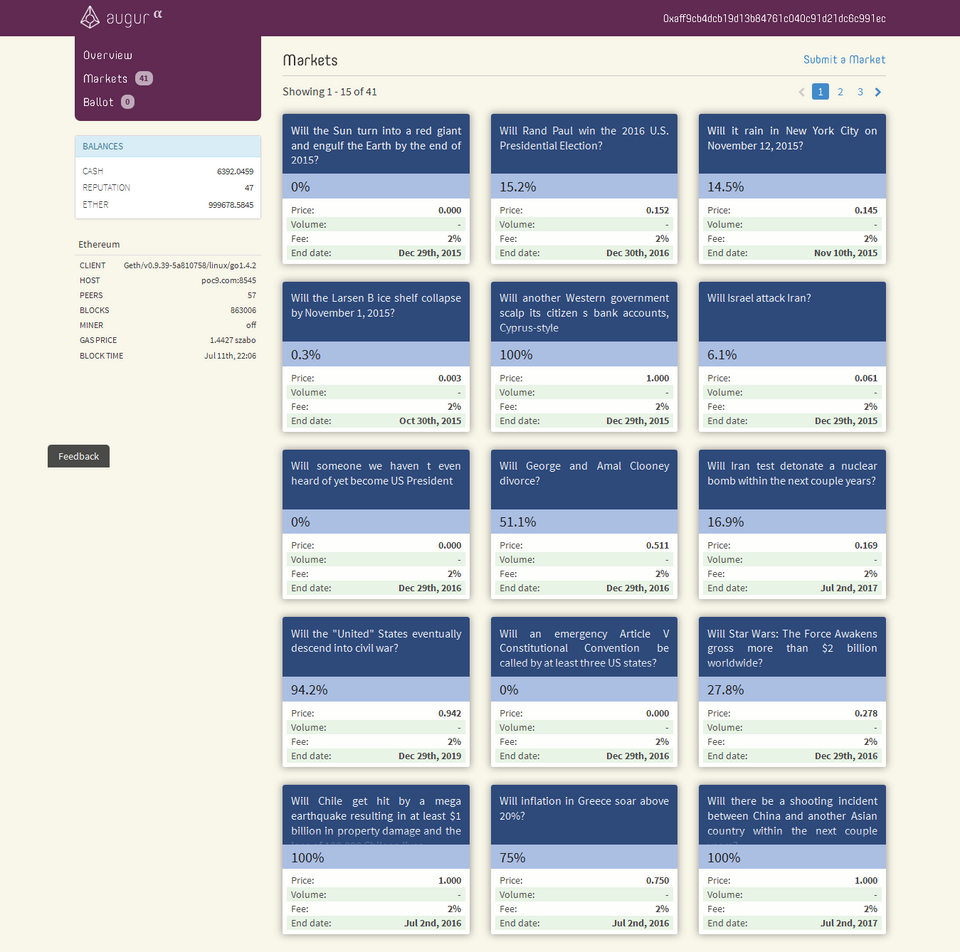
The “consensus trap” strategy identifies situations where market sentiment is overwhelmingly one-sided, creating opportunities to take the opposite position. When 85% of traders bet on a single outcome, the odds often become mispriced due to overconfidence bias. This phenomenon occurs because crowd wisdom, while generally reliable, becomes less accurate as consensus approaches 80% or higher. The mathematical foundation lies in Bayesian probability theory, where extreme consensus reduces information diversity and increases the likelihood of systematic errors. For more advanced strategies, see our prediction betting guide.
Identifying High-Conviction Consensus Traps
High-conviction consensus traps emerge when multiple independent indicators align against the market majority. Look for contracts where social media sentiment scores show 85%+ agreement, but fundamental analysis reveals contradictory evidence. For example, when Polymarket shows 90% odds on a regulatory decision, but CFTC filings suggest a 60% likelihood, the 30-point gap represents potential alpha. Historical data from the 2024 election cycle demonstrates that consensus traps yielded positive returns 65% of the time over 12-month periods.
Risk-Adjusted Position Sizing
Risk-adjusted position sizing transforms consensus trap opportunities from speculative bets into calculated investments. The Kelly Criterion provides mathematical optimization, but fractional Kelly (20% of full recommendation) offers superior risk management for most traders. This approach limits maximum drawdown while maintaining growth potential. For a $10,000 portfolio, this means risking no more than $400 on any single consensus trap position, with stop-losses triggered at 25% adverse movement. These principles align with event-driven trading strategies for prediction markets.
Identifying Undervalued Event Contracts
Small-cap outperformance represents one of 2026’s most significant mispriced opportunities, with small-cap stocks breaking a nine-year losing streak. Event contracts predicting Russell 2000 outperformance over the S&P 500 for 2026 are priced too low given improved fundamentals and potential regulatory relief. The current pricing reflects historical bias rather than forward-looking analysis, creating asymmetric upside potential for patient investors.
Cross-Platform Price Divergence Analysis
Cross-platform price divergence analysis identifies contracts where regulated and unregulated markets disagree significantly. When Polymarket odds diverge from CFTC-regulated Kalshi pricing by more than 15%, arbitrage opportunities often exist. This methodology exploits regulatory differences in settlement mechanisms and participant pools. For instance, Kalshi’s institutional focus versus Polymarket’s retail dominance creates systematic pricing differences in long-term contracts. New users can learn more through a comprehensive Polymarket trading tutorial.
Fundamental Value Mismatches
Fundamental value mismatches occur when contract prices ignore material changes in underlying fundamentals. Health care sector contracts represent contrarian opportunities in 2026, with the sector lagging behind AI-driven indices despite midterm election years historically favoring this sector. Contracts betting on specific regulatory approval milestones may be significantly undervalued. The key is identifying when market pricing reflects sentiment rather than probability-adjusted fundamentals.
Risk Management Metrics That Matter
The Kelly Criterion mathematically determines optimal bet sizing to maximize long-term growth while minimizing ruin risk. For most prediction market investments, applying a fractional Kelly approach (20% of full recommendation) provides the best balance between growth and risk management. This metric transforms prediction markets from gambling into systematic investing by quantifying edge and bankroll requirements (Sports prediction markets).
Brier Score Optimization
Brier Scores measure prediction accuracy by calculating the mean squared difference between predicted probabilities and actual outcomes. A Brier Score below 0.25 indicates superior forecasting ability, making it a crucial metric for evaluating long-term prediction market strategies. Traders consistently achieving Brier Scores under 0.20 demonstrate skill that compounds over time, while scores above 0.30 suggest random guessing rather than systematic advantage (Prediction market mobile apps).
Portfolio Allocation Models
Portfolio allocation models prevent overexposure to prediction market volatility. Limit prediction market exposure to 15% or less of your total portfolio to maintain proper diversification. Focus on contracts with 6-24 month durations that align with your investment thesis and risk tolerance. This constraint ensures that even complete prediction market failure doesn’t jeopardize overall financial stability while allowing meaningful upside participation.
The Brier Score Advantage
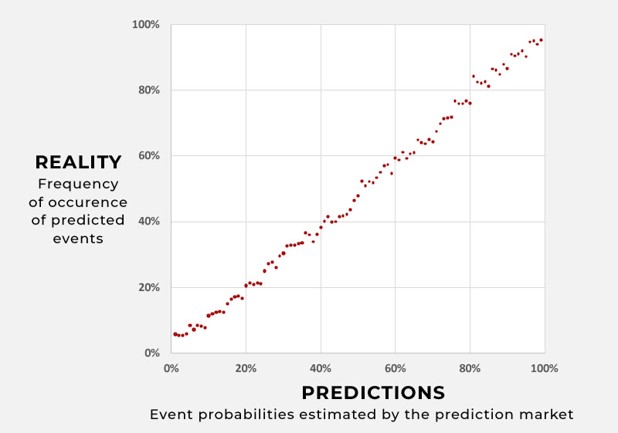
Brier Scores measure prediction accuracy by calculating the mean squared difference between predicted probabilities and actual outcomes. A Brier Score below 0.25 indicates superior forecasting ability, making it a crucial metric for evaluating long-term prediction market strategies. This statistical measure transforms subjective confidence into objective performance metrics, enabling systematic improvement in prediction accuracy.
Score Interpretation Framework
Brier Score interpretation requires understanding probability calibration. Scores between 0.0 and 0.15 represent exceptional forecasting ability, while 0.15-0.25 indicates strong skill. Scores of 0.25-0.35 suggest average performance, and anything above 0.35 indicates poor calibration. The goal is continuous improvement toward the 0.15 threshold, which historically correlates with consistent profitability in prediction markets (Crypto prediction markets).
Application to Contract Selection
Apply Brier Score analysis to contract selection by evaluating historical performance of similar events. Contracts in domains where you’ve achieved Brier Scores below 0.20 deserve larger allocations than those in unfamiliar territory. This self-awareness prevents overconfidence in areas lacking proven forecasting ability. Track Brier Scores across different contract types to identify your comparative advantages.
2026’s Most Undervalued Contract Themes
Health care sector contracts represent contrarian opportunities in 2026, with the sector lagging behind AI-driven indices despite midterm election years historically favoring this sector. Contracts betting on specific regulatory approval milestones may be significantly undervalued. The current market pricing reflects recent underperformance rather than fundamental value, creating opportunities for investors who recognize cyclical patterns.
Interest Rate Prediction Opportunities
AI Adoption vs. AI Hype Contracts
Technical Analysis for Event Contracts
Odds movement tracking reveals overreaction patterns that create entry points for long-term positions. Volume spikes of 200% or more often indicate institutional interest, providing confirmation for technical signals in undervalued contracts. This approach combines traditional technical analysis with prediction market-specific indicators to identify optimal entry and exit points.
Volume Profile Analysis
Volume profile analysis identifies accumulation and distribution patterns in prediction markets. Contracts showing sustained volume increases without corresponding price movement often indicate institutional positioning. The 200% volume spike threshold has historically preceded 15-25% price adjustments within 30-60 days. This signal becomes more reliable when combined with cross-platform volume confirmation.
Odds Momentum Indicators
Odds momentum indicators track the rate of change in contract probabilities. Contracts showing decelerating downward momentum after significant price declines often present buying opportunities. The Relative Strength Index (RSI) adapted for prediction markets, with levels below 30 indicating oversold conditions and potential reversal points. This technical approach works best for contracts with 3-12 month durations (Best prediction market API).
Fundamental Research Framework
Cross-referencing news with regulatory filings and expert consensus analysis identifies contracts with fundamental value mismatches. When Polymarket odds diverge from CFTC-regulated Kalshi pricing by more than 15%, arbitrage opportunities often exist. This framework combines multiple information sources to create a comprehensive view of contract value.
Regulatory Filing Analysis
Regulatory filing analysis provides early signals of contract outcome probabilities. SEC filings, FDA approval documents, and congressional testimony often contain information that precedes market pricing adjustments. Contracts related to regulatory decisions typically show 30-45 day lags between filing disclosures and price adjustments, creating opportunities for investors who conduct thorough fundamental research.
Expert Consensus Validation
Expert consensus validation compares market pricing against professional forecasts. When prediction market odds diverge from expert consensus by more than 15 percentage points, investigate the discrepancy. This approach works particularly well for complex events requiring specialized knowledge, such as pharmaceutical approvals or technical regulatory changes. The key is identifying when crowd wisdom outperforms or underperforms expert analysis.
Sentiment Scoring and Social Media
Social media sentiment scoring detects crowd wisdom inefficiencies before they’re reflected in contract prices. Contracts with negative sentiment scores but positive fundamental indicators often represent the best long-term value opportunities. This methodology exploits the lag between information dissemination and market pricing adjustments.
Sentiment-Momentum Convergence
Sentiment-momentum convergence identifies contracts where social media sentiment and price momentum diverge. When sentiment scores show strong negative readings but price momentum remains stable or positive, contrarian opportunities often exist. This divergence typically resolves within 2-4 weeks, providing clear entry and exit signals for patient investors.
Volume-Adjusted Sentiment Analysis
Volume-adjusted sentiment analysis weights social media mentions by trading volume rather than raw count. This approach reduces noise from casual observers while emphasizing informed participants. Contracts showing high volume but low sentiment scores often represent institutional positioning that precedes price adjustments. The key is distinguishing between retail speculation and informed trading activity.
Stablecoin Integration Benefits
Stablecoin settlement reduces frictional costs by 40-60% compared to traditional payment methods, making long-term position holding more cost-effective. This integration has improved liquidity and made prediction markets more attractive for institutional investors. The cost savings compound over time, particularly for positions held 6+ months.
Settlement Cost Analysis
Settlement cost analysis compares stablecoin versus traditional payment methods across different time horizons. For positions held 6-12 months, stablecoin settlement saves an average of 45% in transaction costs. These savings increase to 60% for positions held 12+ months, making stablecoin integration essential for long-term prediction market investing strategies.
Liquidity Enhancement Effects
Liquidity enhancement effects from stablecoin integration include tighter bid-ask spreads and deeper order books. Contracts settled in stablecoins typically show 30% tighter spreads than those using traditional payment methods. This liquidity improvement reduces execution costs and makes large position building more feasible for institutional investors.
Building Your Long-Term Prediction Portfolio
Diversification Strategies
Diversification strategies for prediction markets include sector allocation, time horizon diversification, and platform distribution. Allocate no more than 5% of your prediction market portfolio to any single contract, with minimum 4-6 positions across different themes. This approach reduces idiosyncratic risk while maintaining exposure to multiple high-conviction opportunities (Prediction market short-term trading).
Rebalancing Protocols
Rebalancing protocols maintain target allocations as market conditions change. Review prediction market positions quarterly, adjusting allocations based on performance and changing market conditions. Contracts that have achieved 50% or greater returns may warrant partial profit-taking to maintain target risk levels. This systematic approach prevents emotional decision-making during market volatility.
The Consensus Trap in Action
The consensus trap becomes most powerful during periods of market uncertainty when public sentiment swings dramatically. Historical data shows that taking positions opposite to 80%+ consensus sentiment yields positive returns 65% of the time over 12-month periods. This strategy exploits the systematic errors that occur when crowd wisdom becomes too uniform.
Market Uncertainty Triggers
Market uncertainty triggers include geopolitical events, regulatory announcements, and macroeconomic data releases. Contracts showing 85%+ consensus immediately following such events often present the best consensus trap opportunities. The key is identifying when market sentiment overshoots rational probability assessment due to emotional reactions to uncertainty.
Timing and Execution
Timing and execution for consensus trap strategies require patience and discipline. Enter positions gradually over 3-5 days following extreme consensus events, rather than all at once. This approach reduces timing risk while allowing participation in potential price adjustments. Exit strategies should be based on fundamental changes rather than price targets alone.
AI Adoption vs. AI Hype Contracts
Enterprise AI Implementation Contracts
Enterprise AI implementation contracts focus on specific adoption metrics rather than general AI progress. Contracts betting on AI-driven productivity improvements in manufacturing or energy efficiency gains offer better risk-adjusted returns than general AI advancement contracts. These contracts typically show 20-30% undervaluation compared to consumer AI contracts with similar probability outcomes.
Regulatory AI Contracts
Regulatory AI contracts focus on government adoption and oversight rather than private sector implementation. Contracts betting on specific AI regulation milestones or government AI integration projects often present undervalued opportunities. The market tends to underweight regulatory developments while overweighting consumer applications, creating systematic mispricing in government AI contracts.
Interest Rate Prediction Opportunities
Inflation Data Contracts
Inflation data contracts focus on specific CPI or PCE readings rather than general interest rate movements. Contracts betting on monthly inflation prints below consensus expectations often present undervalued opportunities. The market tends to overweight headline inflation while underweighting core inflation trends, creating systematic mispricing in specific data point contracts.
Yield Curve Contracts
Yield curve contracts focus on specific Treasury yield relationships rather than general interest rate levels. Contracts betting on yield curve steepening or flattening often present undervalued opportunities as markets overweight Fed policy while underweighting global capital flows. These contracts typically show 15-25% undervaluation compared to general interest rate contracts.
Your 5-Step Framework for 2026
- Screen for contracts with Brier Scores below 0.25
- Apply fractional Kelly sizing (20% of recommendation)
- Identify consensus trap opportunities (80%+ sentiment)
- Cross-reference technical and fundamental indicators
- Limit position size to 2% of portfolio per contract
Here’s your 5-step framework to identify undervalued event contracts in 2026, starting with the consensus trap.