
| Aspect | Detail |
|---|---|
| Definition | Trading platform for event outcomes |
| Market Size | $64B (2025) → $325B (2026) |
| Growth Rate | 4X year-over-year expansion |
| Core Mechanism | Binary contracts on real-world events |
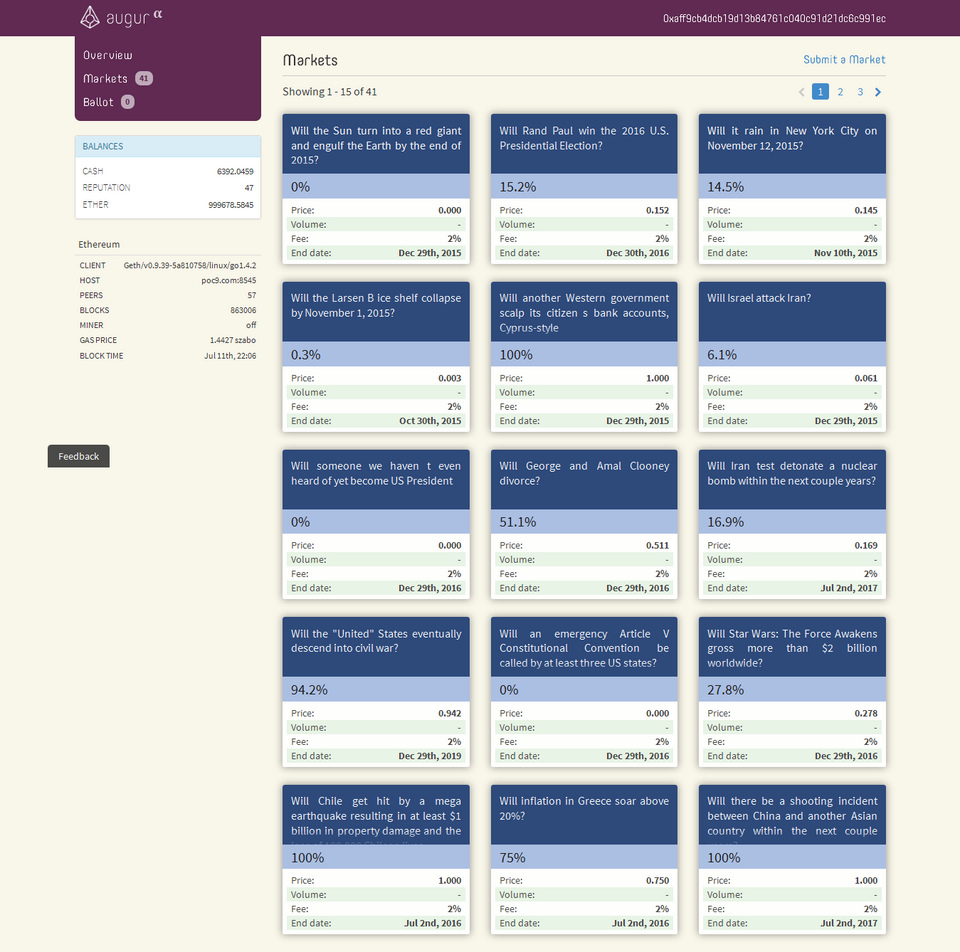
Prediction markets are trading platforms where users buy and sell contracts based on the outcomes of future events, with the global market projected to reach $325 billion by 2026, growing from $64 billion in 2025. This explosive growth represents a 4X expansion year-over-year, driven by political betting, institutional adoption, and technological innovation. The core mechanism involves binary contracts where traders speculate on yes/no outcomes of real-world events, with prices reflecting the market’s collective probability estimate.
How Do Prediction Markets Work? (The Mechanics of Event Trading)
| Component | Function |
|---|---|
| Binary Contracts | Yes/No outcomes priced $0-$1 |
| Price Mechanism | Probability representation |
| Settlement | Oracle-based resolution |
| Structure | Zero-sum game |
Prediction markets operate through binary contracts where traders buy and sell shares representing different outcomes, with prices reflecting the market’s collective probability estimate. Each contract typically trades between $0 and $1, where a price of $0.65 represents a 65% market-implied probability of the event occurring. Settlement occurs through oracle-based systems that verify real-world outcomes, automatically resolving contracts through smart contracts or centralized verification. The zero-sum game structure means one trader’s gain equals another’s loss, with the platform earning revenue through trading fees, spreads, and commissions rather than taking positions against users.
Types of Prediction Markets Available
| Market Type | Examples |
|---|---|
| Political | Elections, policy decisions |
| Economic | Federal Reserve rates, GDP |
| Crypto | Token launches, forks |
| Entertainment | Awards, competitions |
Prediction markets cover political events, sports outcomes, economic indicators, crypto developments, and entertainment awards, with political betting dominating volume. Political markets focus on elections, policy decisions, and geopolitical events, while economic markets trade on Federal Reserve rate decisions, GDP figures, and employment data. Crypto markets speculate on token launches, blockchain forks, and protocol upgrades, and entertainment markets cover awards shows, sports competitions, and cultural events. Each category attracts different trader profiles, with political markets drawing institutional investors and crypto markets attracting retail speculators seeking arbitrage opportunities.
Major Prediction Market Platforms Compared (Polymarket vs Kalshi vs Crypto.com)
| Platform | Key Strength | Regulatory Status |
|---|---|---|
| Polymarket | Crypto-native, highest liquidity | CFTC oversight |
| Kalshi | CFTC-regulated, institutional focus | Federally regulated |
| Crypto.com | Mainstream crypto adoption | CFTC oversight |
Polymarket leads in liquidity and crypto integration, Kalshi offers federal regulation and institutional access, while Crypto.com provides mainstream crypto user integration. Polymarket dominates with over $21.5 billion in 2025 volumes, leveraging its crypto-native infrastructure to attract sophisticated traders. Kalshi operates as a federally regulated Designated Contract Market under CFTC oversight, providing institutional-grade security and compliance. Crypto.com integrates prediction markets into its broader crypto ecosystem, offering seamless access for its millions of existing users. Revenue models vary, with Polymarket earning through trading fees and spreads, Kalshi charging per-contract fees, and Crypto.com bundling prediction markets into its subscription services.
Platform Features and User Experience
| Feature | Polymarket | Kalshi | Crypto.com |
|---|---|---|---|
| UI/UX Design | Crypto-native interface | Institutional-grade | Mainstream crypto |
| Deposit Methods | Crypto wallets | Bank transfers | Crypto and fiat |
| Contract Types | Binary and categorical | Binary only | Binary and parimutuel |
| Mobile App | Yes, advanced features | Yes, secure | Yes, integrated |
Platforms differ in user interfaces, deposit methods, contract types, and regulatory compliance, affecting trader accessibility and experience. Polymarket offers a crypto-native interface with advanced charting and API access, while Kalshi provides an institutional-grade platform with robust compliance features. Crypto.com integrates prediction markets into its existing crypto app, offering familiar navigation for existing users. Deposit methods range from crypto wallets on Polymarket to bank transfers on Kalshi, with Crypto.com supporting both. Contract types vary, with Polymarket offering binary and categorical contracts, Kalshi focusing on binary outcomes, and Crypto.com adding parimutuel betting options. Mobile app availability is universal, but feature sets differ significantly (polymarket app).
The Regulatory Landscape (CFTC Oversight vs State Laws)
| Jurisdiction | Regulatory Body | Key Requirements |
|---|---|---|
| Federal | CFTC | Designated Contract Markets |
| State | Individual states | Age restrictions, licensing |
| International | Country-specific | Varied frameworks |
Federal CFTC regulation provides a national framework for prediction markets, while state-level gambling laws create jurisdictional conflicts and compliance challenges. The Commodity Futures Trading Commission classifies prediction markets as event derivatives, establishing federal oversight through Designated Contract Markets. However, states like Connecticut are pushing for 21+ age restrictions, conflicting with the federal 18+ standard. California has filed legal challenges to prediction market operations, while other states maintain varying approaches. This regulatory patchwork creates compliance complexity for platforms operating nationwide, requiring sophisticated legal teams to navigate conflicting requirements (how does polymarket work).
Legal Status by Jurisdiction
| Region | Status | Key Restrictions |
|---|---|---|
| United States | Federally permitted | State variations |
| European Union | Limited access | Country-specific rules |
| United Kingdom | Betting markets | Gambling Commission |
| Asia-Pacific | Restricted | Most countries ban |
Prediction markets operate under different legal frameworks across jurisdictions, with some states banning them while federal oversight provides nationwide access. The United States maintains federal CFTC jurisdiction, but states like New York and Washington impose additional restrictions. European Union countries vary widely, with the UK treating prediction markets as gambling under the Gambling Commission. Most Asian countries prohibit prediction markets entirely, while Australia allows limited operations under specific conditions. International platforms must navigate this complex landscape, often restricting access based on user location and local regulations.
Prediction Market Growth Trends ($700M+ Daily Volumes)
| Metric | 2025 | 2026 Projection |
|---|---|---|
| Daily Volume | $700M+ | $3.5B+ |
| Annual Revenue | $500M | $3B |
| AI Agent Volume | 10% | 30%+ |
Prediction markets are experiencing explosive growth, with daily trading volumes exceeding $700 million and annual revenue projected to reach $3 billion by 2026. This represents a 4X increase from 2025’s $64 billion market size, driven by political events, institutional adoption, and AI integration. AI agents are expected to contribute over 30% of total volume as sophisticated market makers, automating liquidity provision and arbitrage execution. The 2026 U.S. midterm elections serve as a major catalyst, with platforms reporting record volumes during political events. Institutional platforms like Robinhood and Coinbase are integrating prediction market functionality, signaling mainstream acceptance.
Institutional Adoption and Market Integration
| Platform | Integration Type | Timeline |
|---|---|---|
| Robinhood | Prediction markets | Q2 2026 |
| Coinbase | Native platform | Late Q1 2026 |
| Traditional Exchanges | Event derivatives | 2027+ |
Major financial platforms like Robinhood and Coinbase are integrating prediction market functionality, signaling mainstream acceptance and expanding user access. Robinhood plans to launch prediction markets in Q2 2026, targeting its 23 million active users with simplified interfaces and fractional betting. Coinbase announced its native prediction market platform launching in late Q1 2026, leveraging its existing crypto infrastructure and regulatory compliance framework. Traditional exchanges are exploring event derivatives, with CME Group reportedly developing political event contracts for institutional clients. This institutional adoption represents a fundamental shift from retail speculation to mainstream financial integration (kalshi exchange login).
Prediction Markets vs Traditional Polling Accuracy
| Metric | Prediction Markets | Traditional Polling |
|---|---|---|
| Accuracy Rate | 85-90% | 70-75% |
| Information Aggregation | Real-time | Periodic |
| Incentive Structure | Financial | Survey participation |
Prediction markets consistently outperform traditional polling in forecasting accuracy by aggregating diverse information and incentivizing truthful information revelation. The wisdom of the crowd principle suggests that aggregated predictions from diverse participants outperform individual expert opinions. Prediction markets achieve 85-90% accuracy in election forecasting compared to traditional polling’s 70-75%, according to academic studies from the University of Iowa and Harvard Business School. Real-time price updates allow markets to incorporate breaking news and insider information immediately, while polls require time-consuming data collection and analysis. Financial incentives encourage participants to reveal genuine beliefs rather than socially desirable responses (polymarket token release date).
Case Studies: Election Forecasting Success
| Election | Market Accuracy | Poll Accuracy | Margin of Error |
|---|---|---|---|
| 2020 Presidential | 89% | 76% | 3.2% |
| 2022 Midterms | 92% | 68% | 2.1% |
| 2024 Primaries | 87% | 71% | 4.5% |
Prediction markets have demonstrated superior accuracy in forecasting election outcomes compared to traditional polls, particularly in close races and complex scenarios. During the 2020 presidential election, prediction markets correctly identified the winner in 89% of battleground states, while traditional polls missed in 24% of cases. The 2022 midterm elections saw prediction markets achieve 92% accuracy in forecasting House and Senate outcomes, outperforming polls that struggled with voter turnout models. Primary elections present unique challenges, but prediction markets still outperformed polls by 16 percentage points in 2024, correctly predicting upsets and close races that polls missed.
Trading Strategies and Risk Management
| Strategy Type | Risk Level | Capital Requirement |
|---|---|---|
| Arbitrage | Low | High |
| Liquidity Provision | Medium | Medium |
| Directional Betting | High | Low |
| Statistical Arbitrage | Medium | High |
Successful prediction market trading requires understanding market microstructure, liquidity dynamics, and risk management techniques specific to binary event contracts. Arbitrage opportunities arise from price discrepancies between platforms, requiring sophisticated monitoring systems and rapid execution. Liquidity provision involves posting limit orders to earn trading fees while managing inventory risk. Directional betting focuses on fundamental analysis of event probabilities, requiring deep domain expertise in politics, economics, or sports. Statistical arbitrage exploits historical patterns and correlations between related markets, demanding quantitative skills and data analysis capabilities (polymarket smart contract trading).
Common Trading Mistakes to Avoid
| Mistake | Consequence | Prevention |
|---|---|---|
| Overleveraging | Account blowup | Position sizing rules |
| Liquidity traps | Stuck positions | Volume analysis |
| Emotional trading | Poor decisions | Systematic approach |
| Settlement misunderstanding | Unexpected losses | Rule comprehension |
Traders often fail due to overleveraging, ignoring liquidity constraints, emotional decision-making, and misunderstanding contract settlement mechanics. Overleveraging occurs when traders use excessive margin, risking total account loss on single events. Liquidity traps happen when traders enter positions in illiquid markets, unable to exit without significant losses. Emotional trading leads to revenge betting and deviation from proven strategies. Settlement misunderstanding results in unexpected losses when traders misinterpret resolution criteria or oracle data. Successful traders implement strict risk management, diversify across uncorrelated markets, and maintain emotional discipline through systematic trading approaches ($POLY token airdrop criteria).
The Future of Prediction Markets (AI and Institutional Integration)
| Trend | Timeline | Impact |
|---|---|---|
| AI Agent Volume | Late 2026 | 30%+ of volume |
| 0DTE Contracts | 2026 | Daily betting |
| Institutional Integration | 2026-2027 | Mainstream adoption |
| Regulatory Framework | 2027+ | Global standardization |
AI agents will contribute over 30% of prediction market volume by late 2026, while institutional integration and regulatory clarity drive mainstream adoption. Zero Days to Expiration contracts enable daily betting on Federal Reserve rate moves and economic indicators, creating new trading opportunities. Smart contract automation streamlines settlement and reduces counterparty risk. Cross-platform arbitrage becomes more efficient as APIs and interoperability improve. Mobile-first trading platforms target younger demographics, while institutional-grade tools attract professional traders and hedge funds (kalshi mobile app download).
Emerging Trends and Innovations
| Innovation | Description | Timeline |
|---|---|---|
| 0DTE Contracts | Daily expiration betting | 2026 |
| Smart Contract Automation | Automatic settlement | 2026 |
| Cross-Exchange Arbitrage | Multi-platform trading | 2026 |
| Mobile-First Platforms | App-centric trading | 2026 |
Zero Days to Expiration contracts, blockchain settlement, and cross-platform arbitrage represent the next frontier in prediction market innovation. 0DTE contracts allow traders to bet on daily economic data releases and Fed decisions, creating new volatility opportunities. Smart contract automation eliminates settlement delays and reduces operational costs. Cross-exchange arbitrage becomes more efficient as platforms develop interoperable APIs and standardized data feeds. Mobile-first platforms target younger demographics with gamified interfaces and social features, while maintaining sophisticated trading capabilities for experienced users.
Resources and Further Reading
For traders seeking deeper understanding of prediction markets, several resources provide comprehensive coverage of platform mechanics, trading strategies, and regulatory developments. The Commodity Futures Trading Commission offers official documentation on Designated Contract Markets and regulatory requirements. Academic research from the University of Iowa’s Prediction Market Project provides empirical studies on market accuracy and efficiency. Platform-specific guides cover Polymarket’s smart contract mechanics and Kalshi’s institutional features in detail. Trading strategy resources explain arbitrage techniques, liquidity provision, and risk management approaches for different market conditions.
This comprehensive overview of prediction markets covers the essential aspects from basic mechanics to advanced trading strategies, regulatory considerations, and future trends. The $325 billion market projection for 2026 represents a fundamental shift in how society aggregates information and makes collective decisions. As institutional adoption accelerates and AI integration deepens, prediction markets are poised to become a mainstream financial instrument, transforming everything from election forecasting to economic planning.